
Snow leopards are mountain cats built to survive among the cold, rocky peaks of Central and South Asia.
Their thick fur, wide paws, powerful legs, and extraordinarily long tails help them travel through steep mountains, snow, and freezing temperatures.
Snow leopards are secretive and difficult to see in the wild. Their pale spotted coats provide such good camouflage that they are sometimes called the “ghosts of the mountains.”
What Is a Snow Leopard?
The snow leopard is a large wild cat. Its scientific name is Panthera uncia. Snow leopards belong to the cat family, called Felidae, and the genus Panthera.
Despite their name, snow leopards are a separate species from leopards. They are specially adapted for life in high, cold mountain environments.
Snow leopards are carnivores, which means they eat other animals.
What Do Snow Leopards Look Like?
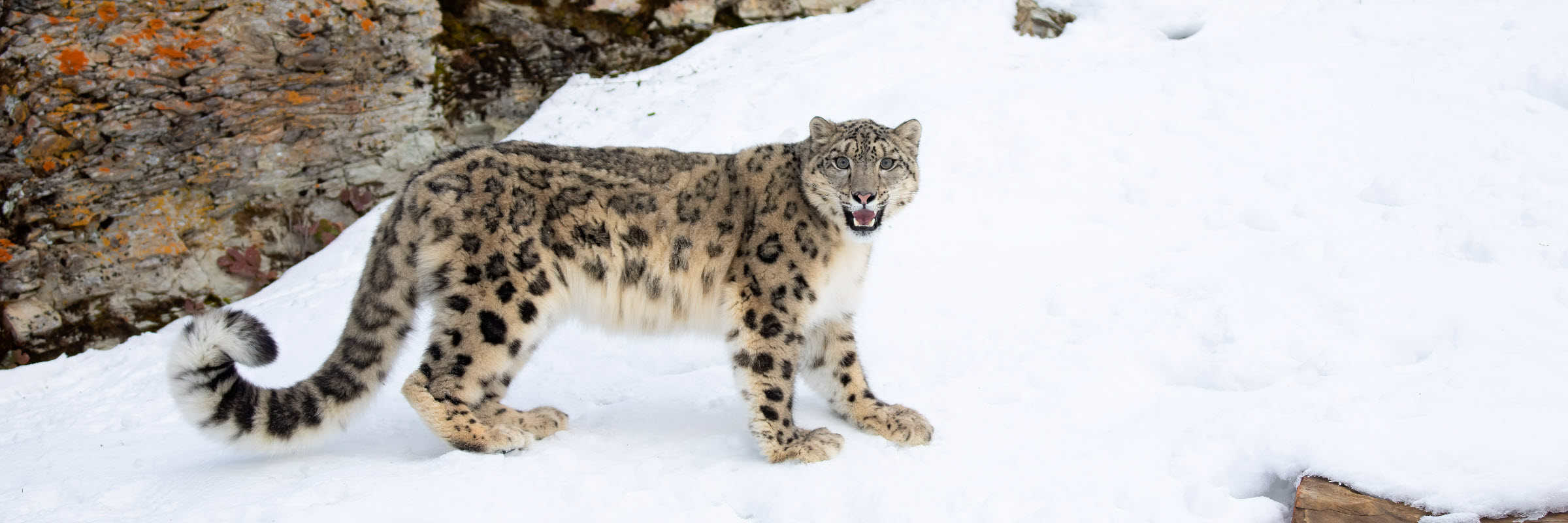
Snow leopards have thick bodies, relatively short front legs, powerful hind legs, broad paws, small rounded ears, and extremely long tails.
Their coats are pale gray, whitish, or smoky gray and covered with dark spots and rosettes. This coloring provides excellent camouflage among rocks, snow, and mountain shadows.
Their fur is extremely thick and helps protect them from freezing temperatures. Wide, furry paws help spread their weight across snow and protect their feet from cold surfaces.
The snow leopard’s long, thick tail helps with balance on steep terrain. A resting snow leopard may also wrap its tail around its body and face for warmth.
What Is the History of Snow Leopards?
Snow leopards belong to the Panthera group of big cats. Over a very long period of time, their ancestors became adapted to the high mountains of Asia. Features such as thick fur, broad paws, powerful legs, and long tails helped them survive in cold and rugged environments.
Scientists use fossils, DNA, tracks, camera traps, and observations to learn about snow leopard history and populations. Because snow leopards live in remote mountain regions and are difficult to see, scientists are still learning about their lives in the wild.
Where Do Snow Leopards Live?
Snow leopards live in the mountains of Central and South Asia. Their range crosses 12 countries, including China, Mongolia, India, Nepal, Bhutan, Pakistan, Afghanistan, Russia, and several countries in Central Asia.
They live among high mountains, rocky slopes, cliffs, valleys, alpine grasslands, and other cold environments. The terrain can be steep and difficult, with freezing winters and relatively little vegetation.
Snow leopards need large areas because their prey may be spread across enormous mountain landscapes.
Snow Leopard Behavior
Snow leopards usually live alone. Adults have large home ranges where they travel, rest, hunt, and search for mates.
They communicate using scent marks, scratches, and sounds. Snow leopards can growl, hiss, meow, chuff, and make a long calling sound sometimes described as a yowl. Unlike lions, tigers, jaguars, and leopards, snow leopards cannot produce a full deep roar.
They are remarkable climbers and jumpers. Their powerful hind legs allow them to leap across gaps and move over steep, broken terrain.
What Do Snow Leopards Eat?
Snow leopards hunt animals that live in mountain environments. Important prey includes wild sheep and goats such as blue sheep and ibex. They also eat marmots, hares, birds, and other animals.
What they eat depends on the region and which prey is available. When wild prey becomes scarce, snow leopards may sometimes attack livestock.
How Do Snow Leopards Hunt?
Snow leopards are ambush predators. Their pale coats help them blend into rocks and snow as they approach prey. They often use cliffs, ridges, and uneven terrain as cover.
Powerful hind legs allow them to make impressive leaps when attacking or traveling across mountain slopes. Sharp claws help them grip rocky terrain and catch prey.
Snow leopards usually hunt alone.
Reproduction and Life Cycle
Baby snow leopards are called cubs. Snow leopards usually mate during winter. A female is pregnant for about three months.
She gives birth in a sheltered den among rocks or cliffs. The den may be lined with fur pulled from the mother’s body. Newborn cubs depend completely on their mother.
As they grow, they begin exploring, playing, and following her through the mountains. The mother teaches the cubs the skills they need to travel and hunt before they eventually become independent.
Snow Leopard Traits
- Snow leopards have extremely thick fur. It protects them from freezing mountain temperatures.
- Their paws are broad and furry. Wide paws help them move over snow and protect their feet from cold surfaces.
- They have very long tails. The tail helps with balance and can also be wrapped around the body for warmth.
- They are powerful jumpers. Strong hind legs help them travel across steep and broken mountain terrain.
- Their pale coats provide excellent camouflage. Snow leopards can be extremely difficult to see among rocks and snow.
- Snow leopards cannot make a full deep roar. They communicate with several other calls instead.
Why Snow Leopards Are Important
Snow leopards are major predators in some of the world’s highest mountain ecosystems. They hunt wild sheep, goats, and other animals and are part of the natural relationships between predators and prey.
Protecting the huge mountain landscapes needed by snow leopards can also help protect many other animals and plants. These mountain environments are also important sources of water for people and wildlife living downstream.
Why Snow Leopards Should Be Protected
Snow leopards are Vulnerable, which means they face a high risk of extinction in the wild. They face several threats across their mountain range.
Development, roads, mining, and other activities can change or divide their habitat. Declining populations of wild sheep and goats can reduce the food available to snow leopards.
When snow leopards attack livestock, herders may kill them in response. Illegal hunting and wildlife trade are additional dangers. Climate change may also alter some of the cold mountain environments where snow leopards and their prey live.
Protecting snow leopards means protecting connected mountain habitats, maintaining healthy populations of wild prey, reducing illegal killing, and helping people protect livestock while living alongside these cats.
Words to Know
Ambush Predator — an animal that hides or approaches quietly before making a sudden attack on prey
Camouflage — colors, patterns, or shapes that help an animal blend into its surroundings
Carnivore — an animal that eats other animals
Cub — a young snow leopard
Ecosystem — a community of living things and the environment around them
Felidae — the scientific family that includes all cats
Habitat — the place where an animal lives and finds what it needs to survive
Home Range — the area where an animal normally lives and travels
Ibex — a wild goat that lives in mountain environments
Predator — an animal that hunts and eats other animals
Prey — an animal that is hunted and eaten by another animal
Rosette — a dark, rose-shaped marking found on the coats of snow leopards and some other wild cats
Vulnerable — facing a high risk of extinction in the wild