Wild cat populations are declining across much of the world. Some species have already disappeared, while many others face increasing pressure from habitat loss, prey decline, human conflict, and illegal trade.
Overview
The following list shows the conservation status of wild cat species, subspecies, and populations based on assessments from the International Union for Conservation of Nature (IUCN) and other sources. These categories reflect the risk of extinction, ranging from Least Concern to Critically Endangered.
Population estimates for wild cats are not maintained in a single global dataset. While conservation status is standardized through the IUCN Red List, population numbers are often derived from a combination of field studies, government surveys, and conservation reports.
Note: A subspecies is a recognized subgroup within a species that has unique physical or genetic traits and usually lives in a specific region. A population refers to a smaller, localized group within a species or subspecies that is managed or studied separately, often because its numbers, range, or threats are different. For example, a species may be listed as Least Concern overall, while a specific population within it is considered Endangered due to isolation or rapid decline.
*Indicates the entire species if there are subspecies.
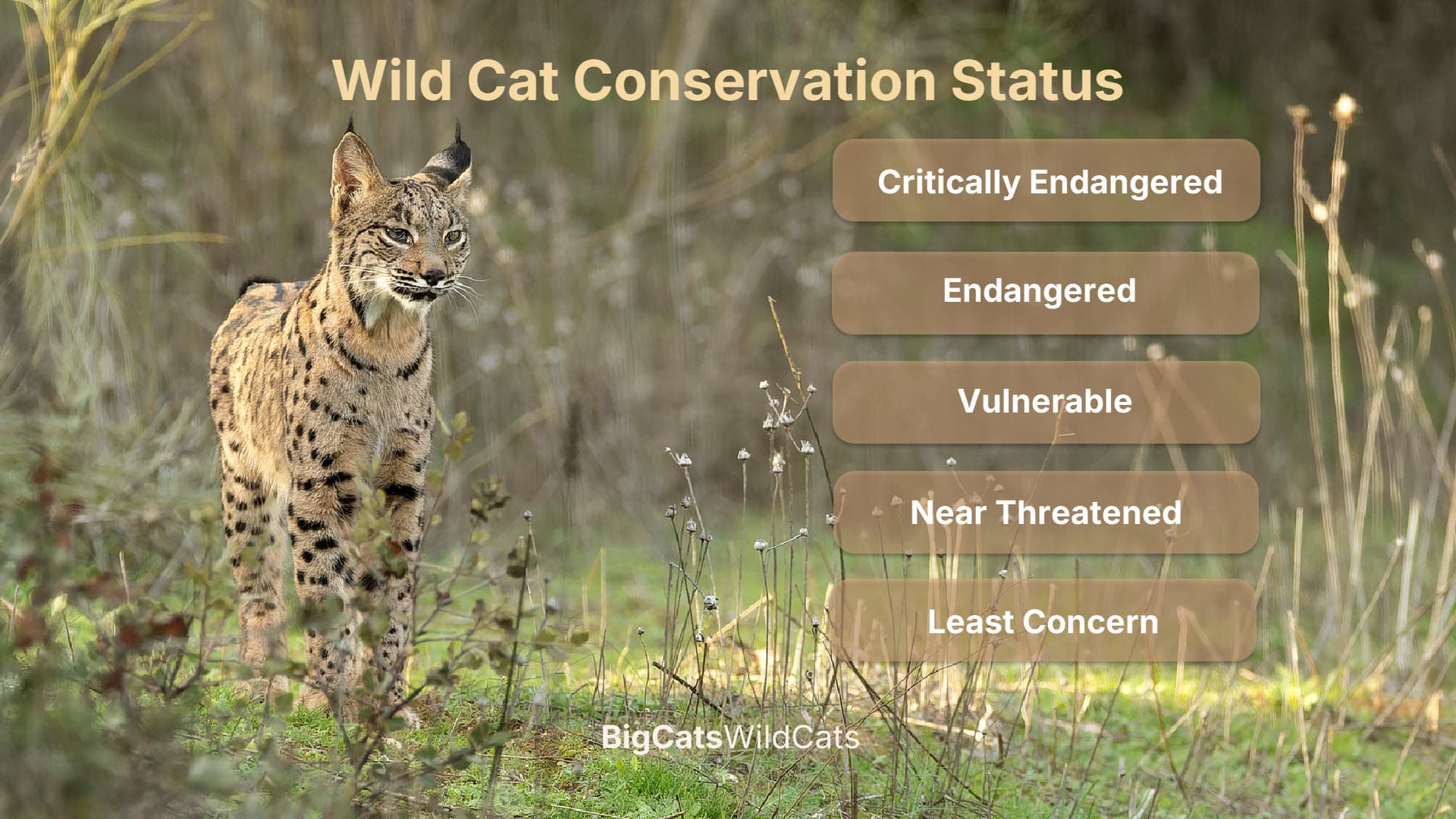
Wild Cat Conservation Status
Where available, estimates below are based on the most recent publicly accessible data. Each entry includes a direct source and citation so readers can review the original research or report. In some cases, ranges or descriptions are used to reflect uncertainty or limited data.
Critically Endangered
Critically Endangered is the most urgent conservation status before extinction in the wild. For some species, populations have dropped to just a few hundred—or even fewer. At that level, survival is no longer just about habitat or prey. It becomes a question of whether the remaining animals can continue as a viable population at all.
With so few individuals, genetic diversity declines. This can lead to inbreeding, reduced fertility, and increased vulnerability to disease. Even if the animals are protected, the population may struggle to recover on its own.
At this stage, recovery often depends on long-term human intervention—protected areas, breeding programs, and intensive monitoring. Without that support, many of these species would not persist in the wild.
Scroll to view full table →
| Size | Species | Common Name | Scientific Name | Status | Current Population Estimate | Source | Notes |
| Big | Leopard | Amur Leopard | Panthera pardus orientalis | Critically Endangered | ~100–120 | IUCN / IUCN CatSG | Population estimate is primarily based on monitoring in Russia. |
| Big | Leopard | Arabian Leopard | Panthera pardus nimr | Critically Endangered | ~100–120 | IUCN / IUCN CatSG | Population is fragmented across the Arabian Peninsula. |
| Big | Leopard | Indochinese Leopard | Panthera pardus delacouri | Critically Endangered | ~100–800 | IUCN / IUCN CatSG | Population is fragmented across Southeast Asia. |
| Big | Tiger | Malayan Tiger | Panthera tigris jacksoni | Critically Endangered | ~80–150 | IUCN / IUCN CatSG | Wild population has declined sharply in recent decades. |
| Big | Tiger | South China Tiger | Panthera tigris amoyensis | Critically Endangered | Possibly extinct in the wild | IUCN / IUCN CatSG | No confirmed wild population; survives only in captivity. |
| Big | Tiger | Sumatran Tiger | Panthera tigris sumatrae | Critically Endangered | ~400–600 | IUCN / IUCN CatSG | Restricted to the island of Sumatra. |
| Big | Cheetah | Asiatic Cheetah | Acinonyx jubatus venaticus | Critically Endangered | ~12 | IUCN / IUCN CatSG | A tiny wild population remains in Iran. |
| Big | Cheetah | Northwest African Cheetah | Acinonyx jubatus hecki | Critically Endangered | ~200–250 | IUCN / IUCN CatSG | Small, scattered populations remain in the Sahara and Sahel. |
| Small | Leopard Cat | Iriomote Cat | Prionailurus bengalensis iriomotensis | Critically Endangered | ~100 | IUCN / IUCN CatSG | Endemic to Iriomote Island, Japan. |
| Medium | Eurasian Lynx | Balkan Lynx | Lynx lynx balcanicus | Critically Endangered | ~30–50 | IUCN / IUCN CatSG | A small, highly fragmented population remains in the Balkans. |
Endangered
Endangered species still have viable populations, but their numbers are declining and their long-term survival is not guaranteed. In many cases, these animals are losing habitat, prey, or safe territory faster than they can adapt.
At this stage, populations may still be large enough to function, but pressures are building. Some groups become isolated, making it harder for individuals to find mates and maintain genetic diversity over time. Without intervention, these declines can accelerate and push a species closer to critically low numbers.
Conservation efforts at this level can still be effective, but they require sustained protection of habitat, stable prey populations, and reduced conflict with people. Without those conditions, Endangered species can move quickly into more severe categories.
Scroll to view full table →
| Size | Species | Common Name | Scientific Name | Status | Current Population Estimate | Source | Notes |
| Small | Andean Mountain Cat | Andean Mountain Cat | Leopardus jacobita | Endangered | ~2,200 mature individuals | IUCN / IUCN CatSG | Population is small and fragmented across the high Andes. |
| Small | Flat-headed Cat | Flat-headed Cat | Prionailurus planiceps | Endangered | <2,500 mature individuals | IUCN / IUCN CatSG | A rare wetland specialist with a patchy distribution. |
| Big | Tiger | Tiger* | Panthera tigris | Endangered | ~3,700–5,600 | IUCN | Global estimate across all surviving subspecies. |
| Big | Lion | Asiatic Lion | Panthera leo persica | Endangered | ~650–700 | Gujarat Forest Department / IUCN CatSG | Restricted to a single wild population in and around Gir, India. |
| Big | Leopard | Javan Leopard | Panthera pardus melas | Endangered | ~180–680 mature individuals | IUCN / IUCN CatSG | Confined to fragmented habitat on the island of Java. |
| Big | Leopard | Persian Leopard | Panthera pardus tulliana | Endangered | ~750–1,044 | IUCN / IUCN CatSG | The main stronghold is in Iran, but populations remain fragmented. |
| Big | Tiger | Amur Tiger | Panthera tigris altaica | Endangered | ~450–500 | IUCN | Occurs mainly in the Russian Far East and nearby northeast China. |
| Big | Tiger | Bengal Tiger | Panthera tigris tigris | Endangered | ~2,600–3,300 | IUCN | This is the largest remaining tiger population. |
| Big | Tiger | Indochinese Tiger | Panthera tigris corbetti | Endangered | ~350 | IUCN | A small, declining population remains in mainland Southeast Asia. |
| Big | Cheetah | Northeast African Cheetah | Acinonyx jubatus soemmeringii | Endangered | Unknown | IUCN | Occurs in the Horn of Africa and nearby areas, but population size is poorly quantified. |
Vulnerable
Vulnerable species are not yet at immediate risk of extinction, but the conditions that support them are changing. Habitat loss, declining prey, and human expansion are beginning to reduce their numbers or limit where they can live.
Populations at this level are often still large enough to function, but they may be shrinking, becoming more fragmented, or losing access to key resources. These changes can happen slowly, and the impact is not always obvious at first.
This is often the stage where conservation efforts can have the greatest effect. If pressures are reduced and habitats are protected, populations can stabilize. If not, these species can move into more severe risk categories over time.
Scroll to view full table →
| Size | Species | Common Name | Scientific Name | Status | Current Population Estimate | Source | Notes |
| Small | Bornean Bay Cat | Bornean Bay Cat | Catopuma badia | Vulnerable | <2,500 mature individuals | IUCN / IUCN CatSG | A rare and poorly studied species found only on Borneo. |
| Big | Cheetah | Cheetah | Acinonyx jubatus | Vulnerable | ~6,500–7,100 | IUCN | Global population fragmented across Africa with a small population in Iran. |
| Medium | Clouded Leopard | Clouded Leopard | Neofelis nebulosa | Vulnerable | <10,000 mature individuals | IUCN / IUCN CatSG | Population is difficult to estimate due to dense forest habitat. |
| Medium | Iberian Lynx | Iberian Lynx | Lynx pardinus | Vulnerable | ~1,500–2,000 | IUCN / IUCN CatSG | Population has recovered significantly due to conservation programs. |
| Medium | Sunda Clouded Leopard | Sunda Clouded Leopard | Neofelis diardi | Vulnerable | <10,000 mature individuals | IUCN / IUCN CatSG | Occurs on Borneo and Sumatra in fragmented forest habitats. |
| Medium | African Golden Cat | African Golden Cat | Caracal aurata | Vulnerable | Unknown | IUCN / IUCN CatSG | A secretive forest species that is rarely observed. |
| Small | Black-footed Cat | Black-footed Cat | Felis nigripes | Vulnerable | <10,000 mature individuals | IUCN / IUCN CatSG | One of the smallest wild cats, found in southern Africa. |
| Small | Chinese Mountain Cat | Chinese Mountain Cat | Felis bieti | Vulnerable | Unknown | IUCN / IUCN CatSG | Endemic to western China; population is poorly known. |
| Medium | Fishing Cat | Fishing Cat | Prionailurus viverrinus | Vulnerable | <10,000 mature individuals | IUCN / IUCN CatSG | Declining due to wetland loss across South and Southeast Asia. |
| Small | Northern Tiger Cat | Northern Tiger Cat | Leopardus tigrinus | Vulnerable | <10,000 mature individuals | IUCN / IUCN CatSG | Taxonomy revisions affect population estimates. |
| Small | Southern Tiger Cat | Southern Tiger Cat | Leopardus guttulus | Vulnerable | Unknown | IUCN | A recently recognized species with limited data. |
| Big | Lion | African Lion | Panthera leo | Vulnerable | ~20,000–25,000 | IUCN | Population declining across most of its range. |
| Big | Leopard | Leopard* | Panthera pardus | Vulnerable | Unknown | IUCN | Widespread but declining across Africa and Asia. |
| Big | Leopard | African Leopard | Panthera pardus pardus | Vulnerable | Unknown | IUCN | Largest remaining leopard population but declining. |
| Big | Leopard | Sri Lankan Leopard | Panthera pardus kotiya | Vulnerable | ~800–1,000 | IUCN | Endemic to Sri Lanka. |
| Big | Cheetah | Southeast African Cheetah | Acinonyx jubatus jubatus | Vulnerable | ~3,500–4,000 | IUCN | The largest remaining cheetah population. |
| Big | Snow Leopard | Snow Leopard | Panthera uncia | Vulnerable | ~4,000–6,500 | IUCN / IUCN CatSG | Widely distributed across Central Asia in remote mountain regions. |
| Medium | Asiatic Golden Cat | Asiatic Golden Cat | Catopuma temminckii | Vulnerable | Unknown | IUCN / IUCN CatSG | Widespread but declining across Asia. |
Near Threatened
Near Threatened species are not currently considered at high risk, but they are close to meeting the criteria for a more serious classification. In many cases, populations are stable in some areas but declining in others, or their habitat is beginning to change.
At this stage, the warning signs are often subtle. A species may still be widespread, but pressures such as habitat loss, reduced prey, or human expansion are starting to have an effect. These changes may not be obvious yet, but they can build over time.
Near Threatened is often a transition point. If conditions continue to decline, these species can move into higher risk categories. If conditions improve, they may remain stable.
Scroll to view full table →
| Size | Species | Common Name | Scientific Name | Status | Current Population Estimate | Source | Notes |
| Big | Jaguar | Jaguar | Panthera onca | Near Threatened | ~15,000 | IUCN | Population declining; strongest populations remain in the Amazon basin. |
| Small | Pampas Cat | Pampas Cat | Leopardus colocola | Near Threatened | Unknown | IUCN | Taxonomy under revision; population unclear due to species complex classification. |
| Small | Marbled Cat | Marbled Cat | Pardofelis marmorata | Near Threatened | Unknown | IUCN / IUCN CatSG | Elusive forest species with limited field data. |
| Big | Leopard | Indian Leopard | Panthera pardus fusca | Near Threatened | ~12,000–14,000 | IUCN | Largest leopard population outside Africa; impacted by habitat loss and human conflict. |
| Small | Margay | Margay | Leopardus wiedii | Near Threatened | Unknown | IUCN / IUCN CatSG | Arboreal forest species declining due to deforestation. |
| Small | Rusty-spotted Cat | Rusty-spotted Cat | Prionailurus rubiginosus | Near Threatened | Unknown | IUCN / IUCN CatSG | One of the smallest wild cats; population not well quantified. |
Least Concern
Least Concern means a species is not currently at risk of extinction, usually because it has a wide range or a relatively large population. However, this does not mean the species is free from threats or that its population is stable everywhere.
Many Least Concern species are declining in parts of their range due to habitat loss, reduced prey, or increasing human activity. In some areas they remain common, while in others they are becoming harder to find.
This category reflects where a species stands today, not where it is heading. Changes in habitat, food availability, or human pressure can shift populations over time, sometimes gradually and without immediate notice.
Scroll to view full table →
| Size | Species | Common Name | Scientific Name | Status | Current Population Estimate | Source | Notes |
| Small | Kodkod | Kodkod | Leopardus guigna | Least Concern | <20,000 | IUCN / IUCN CatSG | Population declining due to habitat loss in Chile and Argentina. |
| Medium | Bobcat | Bobcat | Lynx rufus | Least Concern | ~2 million+ | IUCN | Stable and widespread across North America. |
| Medium | Canada Lynx | Canada Lynx | Lynx canadensis | Least Concern | ~50,000 | IUCN | Population fluctuates with snowshoe hare cycles. |
| Medium | Caracal | Caracal | Caracal caracal | Least Concern | Widespread | IUCN | Wide distribution across Africa, Middle East, and Asia. |
| Medium | Eurasian Lynx | Eurasian Lynx | Lynx lynx | Least Concern | ~50,000 | IUCN | Recovering in parts of Europe. |
| Small | Geoffroy’s Cat | Geoffroy’s Cat | Leopardus geoffroyi | Least Concern | ~40,000–80,000 | IUCN | Relatively stable but impacted by habitat conversion. |
| Medium | Jungle Cat | Jungle Cat | Felis chaus | Least Concern | Widespread | IUCN | Broad range across Asia and the Middle East. |
| Small | Leopard Cat | Leopard Cat | Prionailurus bengalensis | Least Concern | Widespread | IUCN | Highly adaptable species across Asia. |
| Small | Leopard Cat | Sunda / Javan Leopard Cat | Prionailurus bengalensis javanensis | Least Concern | Unknown | IUCN / IUCN CatSG | Subspecies of leopard cat found in Southeast Asia. |
| Medium | Ocelot | Ocelot | Leopardus pardalis | Least Concern | ~40,000–50,000 | IUCN | Stable overall but declining in parts of its range. |
| Small | Pallas’s Cat | Pallas’s Cat | Otocolobus manul | Least Concern | <20,000 | IUCN / IUCN CatSG | Patchy distribution; sensitive to habitat change. |
| Small | Sand Cat | Sand Cat | Felis margarita | Least Concern | Unknown | IUCN | Adapted to desert environments. |
| Medium | Serval | Serval | Leptailurus serval | Least Concern | Widespread | IUCN | Common in parts of Africa. |
| Small | Wildcat | European Wildcat | Felis silvestris | Least Concern | Unknown | IUCN / IUCN CatSG | Widespread across Europe; populations fragmented. |
| Small | Wildcat | Scottish Wildcat | Felis silvestris silvestris | Least Concern* | ~100–300 (regional) | IUCN / regional data | Critically endangered in Scotland; not separately assessed by IUCN. |
| Small | Wildcat | Afro-Asiatic Wildcat | Felis lybica | Least Concern | Widespread | IUCN | Genetic mixing with domestic cats is a concern. |
| Medium | Jaguarundi | Jaguarundi | Herpailurus yagouaroundi | Least Concern | Unknown | IUCN | Widespread across Central and South America. |
| Big | Cougar | Cougar* | Puma concolor | Least Concern | ~50,000+ | IUCN | Extremely wide range across the Americas. |
Many wild cat species are experiencing long-term population declines. Even species listed as Least Concern depend on stable habitats and prey populations, and can quickly become threatened if those systems are disrupted.
Annual Conservation Status Update (2026)
This update highlights recent changes in wild cat conservation status based on IUCN Red List assessments and amendments. Dates reflect when assessments or updates were published or revised.
- 2025 (assessment update) – Kodkod (Guiña): Reclassified from Vulnerable to Least Concern based on updated data and improved understanding of its distribution. This change reflects improved assessment data rather than a confirmed increase in population.
- 2025 (assessment update) – Asiatic Golden Cat: Uplisted from Near Threatened to Vulnerable, reflecting increasing pressure on forest habitats and ongoing threats across its range.
- 2021 assessment (amended 2025) – Javan Leopard: Classified as Endangered under current IUCN criteria. Earlier listings and interpretations varied, but current status reflects updated assessment methodology and data.
- 2025 (amended assessments) – Indochinese Leopard and other subspecies: Continued recognition of severe regional declines, particularly in Southeast Asia. Subspecies-level assessments are often updated through amendments rather than full reassessments.
- 2025 (assessment amendments) – Multiple species: Species including lions, Canada lynx, and Geoffroy’s cat received updated assessments or amendments without a change in conservation category, reflecting improved data rather than a shift in population status.
- June 2024 – Iberian Lynx: Downlisted from Endangered to Vulnerable following sustained population recovery efforts in Spain and Portugal. This marks one of the most successful wild cat conservation outcomes in recent decades.
These updates highlight an important aspect of conservation assessment: changes in status do not always reflect rapid population shifts. In many cases, they reflect improved data, revised methodologies, or a better understanding of species distribution and threats.