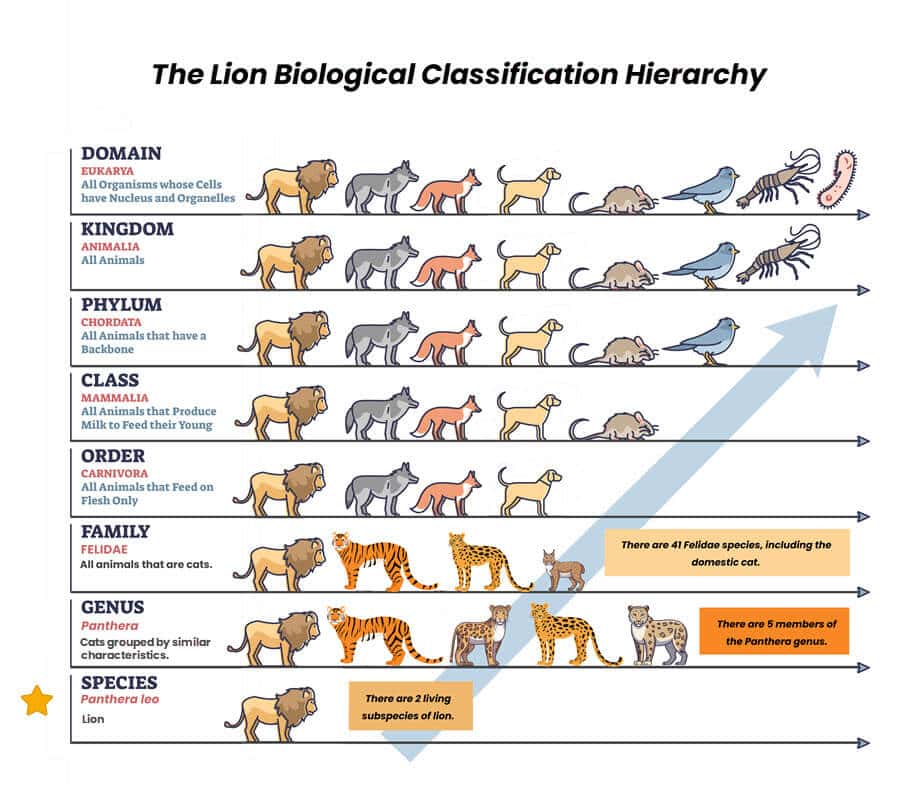
Like all animals, cats are classified based on the traits they share. Cat classification, including both wild and domestic cats, begins with the Felidae family, which groups all cat species based on shared physical and biological characteristics.
What is Biological Classification
Biological classification, also called taxonomy, refers to the naming, defining, and grouping of biological organisms based on similar characteristics. Before modern taxonomy, organisms were often grouped based on simple observations such as habitat or general appearance. Early classification systems were inconsistent and varied widely between cultures and scientists.
In the 18th century, Swedish botanist Carl Linnaeus developed a standardized system for naming and classifying living things. He introduced binomial nomenclature, a two-part scientific naming system that assigns each species a genus name and a species name. This system made it possible for scientists around the world to refer to the same organism using a consistent name.
Linnaeus also organized organisms into a hierarchy of groups based on shared physical characteristics. This structure—ranging from broad categories like kingdom down to specific categories like species—became the foundation of modern biological classification.
Over time, advances in science, particularly in genetics and DNA analysis, have refined this system. Scientists now use both physical traits and genetic data to determine how species are related. This has led to more accurate classifications and a better understanding of how different groups of animals evolved.
For wild cats, modern taxonomy has helped scientists identify relationships between species that may look very different but share a common ancestor. It has also revealed how wild cats are divided into distinct evolutionary lineages, providing insight into their history and development over millions of years.
Domain
The domain is the highest rank in biological classification. There are three domains—Archaea, Bacteria, and Eukarya.
Archaea and Bacteria are single-celled prokaryotic microorganisms.
Prokaryotes have neither a distinct nucleus with a membrane nor specialized structures (organelles).
The domain Eukarya contains eukaryotes—organisms whose cells contain a nucleus and organelles. The Kingdoms in the Eukarya domain are Fungi, Plantae, and Animalia.
Wild cats are members of the domain Eukarya.
Kingdom
Today, most scientists generally recognize six kingdoms:
- Archaea
- Bacteria
- Protista (protozoa and algae)
- Fungi (mushrooms, molds, and yeasts)
- Plantae (plants)
- Animalia (animals).
Wild cats are members of the kingdom Animalia.
Phylum
Phylum (plural: phyla) is the classification below kingdom. The term “division” is used for plants.
Organisms are classified in a phylum or division primarily based on their body type. Animals of the phylum Chordata have an internal skeleton and a backbone or notochord (a primitive backbone). This group includes fish, amphibians, reptiles, birds, and mammals. There are approximately 31 phyla in the kingdom Animalia.
Wild cats are part of the phylum Chordata.
Class
Class ranks below phylum. Members of a class share more characteristics than they do with other organisms in the same phylum.
Examples of classes include Mammalia (mammals), Aves (birds), and Reptilia (reptiles).
Members of the class Mammalia are vertebrate animals with milk-producing mammary glands to feed their young, a neocortex region of the brain, fur or hair, and three middle ear bones.
Wild cats are members of the Mammalia class.
Order
Order ranks below class. The groups in an order have more in common than with other members of the same class. There are approximately 26 different orders in biological classification.
Wild cats are members of the Carnivora, the fifth-largest order of mammals. There are two suborders: the Feliformia and the Caniformia. The Feliformia are “cat-like” animals, while the Caniformia are dog-like animals.
Wild cats are members of the suborder Feliformia.
Family
Family ranks below order. Members of the same family are more closely related to each other than other members of the same order. Wild cats and domestic cats belong to the family Felidae. There are approximately 41 living Felidae species. Felidae are also referred to as felids.
The Felidae are divided into two subfamilies: Pantherinae and Felinae.
Genus
Genus (plural: genera) ranks below family. The groups of organisms in a genus share many structural similarities and are closely related. Members of a genus are more closely related to each other than they are to other genera in the same family.
There are currently 14 recognized wild cat genera: Neofelis, Panthera, Leptailurus, Caracal, Leopardus, Pardofelis, Catopuma, Lynx, Acinonyx, Herpailurus, Puma, Otocolobus, Prionailurus and Felis.
Species
Species is below genus and the most basic unit in biological classification. Members of the same species share the same evolutionary history. They are more closely related to each other than other organisms, including other members of the same genus. Members of the same species have both physical and genetic similarities and the same number of chromosomes. Members of the same species also mate with each other and produce offspring.
Each species has a scientific name composed of the genus name and species name.
Some species include groups with such distinctive traits that they are classified as subspecies; in these cases, a subspecies name is added to the end of the species name.
There are approximately 40-41 species of wild cat in the world.
The Evolution of Wild Cats
Feliformia is a suborder of cat-like animals that separated into several families 35 to 50 million years ago. The first cats appeared around 25 million years ago, beginning with the Proailurus and Pseudaelurus.
The Proailurus lived in Europe and Asia between 25 and 30 million years ago. It was a little larger than the domestic cat, had a long tail, large eyes, sharp claws and teeth, and weighed approximately 20 lbs.
The Pseudaelurus inhabited Asia, North America and Europe between 8 and 20 million years ago. The Pseudaelurus came after the Proailurus, and was the first cat to arrive in North America. It showed up on the continent around 18.5 million years ago, and was the size of a cougar.
Wild Cat Lineages
Identifying how the wild cat evolved has been difficult due to their similarities and other issues. Over the years, improvements in DNA research have resulted in the division of felids into eight different lineages. Below is a list of lineages. You can read more about wild cat lineages here.
Panthera lineage
- Genus: Neofelis, Panthera
- Species: clouded leopard, Sunda clouded leopard, tiger, lion, jaguar, leopard.
Caracal lineage
- Genus: Leptailurus, Caracal
- Species: Serval, African golden cat, caracal
Ocelot lineage
- Genus: Leopardus
- Species: Ocelot, margay, pampas cat, oncilla – southern tiger, oncilla – northern tiger cat, Geoffroy’s cat, kodkod
Bay cat lineage
- Genus: Pardofelis, Catopuma
- Species: Marbled cat, the Borneo bay cat and Asian golden cat
Lynx lineage
- Genus: Lynx
- Species: Bobcat, Canada lynx, Eurasian lynx and Iberian lynx.
Puma lineage
- Genus: Acinonyx, Herpailurus, Puma.
- Species: Cheetah, jaguarundi, cougar
Leopard cat lineage
- Genus: Otocolbus, Prionailurus
- Species: Pallas’s cat, rusty-spotted cat, flat-headed cat, leopard cat, Sunda leopard cat, fishing cat and (debated) Andean mountain cat.
Domestic cat lineage
- Genus: Felis
- Species: Jungle cat, black-footed cat, sand cat, Chinese mountain cat, African wildcat, European wildcat, domestic cat
References & Quotes
“Most scientific names for species and subspecies have little or no scientific basis. Many are based on one, a few or even no specimens, with few or no comparisons with related taxa and hence, in particular, many subspecies names are likely to be invalid. However, for many species and subspecies recent research based on more than one line of evidence is not available.” – 2017 A revised taxonomy of the Felidae | Cat Specialist Group, CATnews
“We immediately noticed that the DNA studies seemed to group the 37 species into eight distinct clusters, or “lineages.” We were fascinated—and encouraged—to see that the eight groups defined exclusively by molecular analysis agreed with other kinds of observations, such as that species in one lineage often shared morphological, biological an physiological characteristics found only in their group.” – 2007 The Evolution of Cats | O’Brien, Johnson | Scientific American July 2007
(Def. Morphological: Shape, structure, color, pattern, and size of exterior parts.)