Like all living things on Earth, big cats have a biological classification. These classifications, also called taxonomy, show how different species are related to each other. The main taxonomy groups are Domain, Kingdom, Phylum, Class, Order, Family, Genus, and Species.
What is a Big Cat?
The term big cat can have different meanings depending on how it is used, including:
- The four big cats that roar: lions, tigers, jaguars and leopards
- All the cats in the Panthera genus (tiger, snow leopard, lion, leopard, and jaguar)
- All the cats in the Pantherinae subfamily (tiger, snow leopard, lion, leopard, jaguar, clouded leopard and Sunda clouded leopard)
- All the cats in the Pantherinae subfamily and the two biggest cats (cougar and cheetah) in the Felinae subfamily
In this article, “big cats” includes both Pantherinae species and the two largest Felinae cats (cougar and cheetah).
Big Cat Taxonomy
The classification of living things began with Aristotle over 2,300 years ago. He created two groups, animals and plants, and then divided the animals into three subgroups – animals that could fly, walk, or swim.
In the 1700s, a Swedish botanist named Carl Linnaeus created a system for describing and grouping taxa (organisms). Linnaeus is often referred to as the “father of taxonomy.”
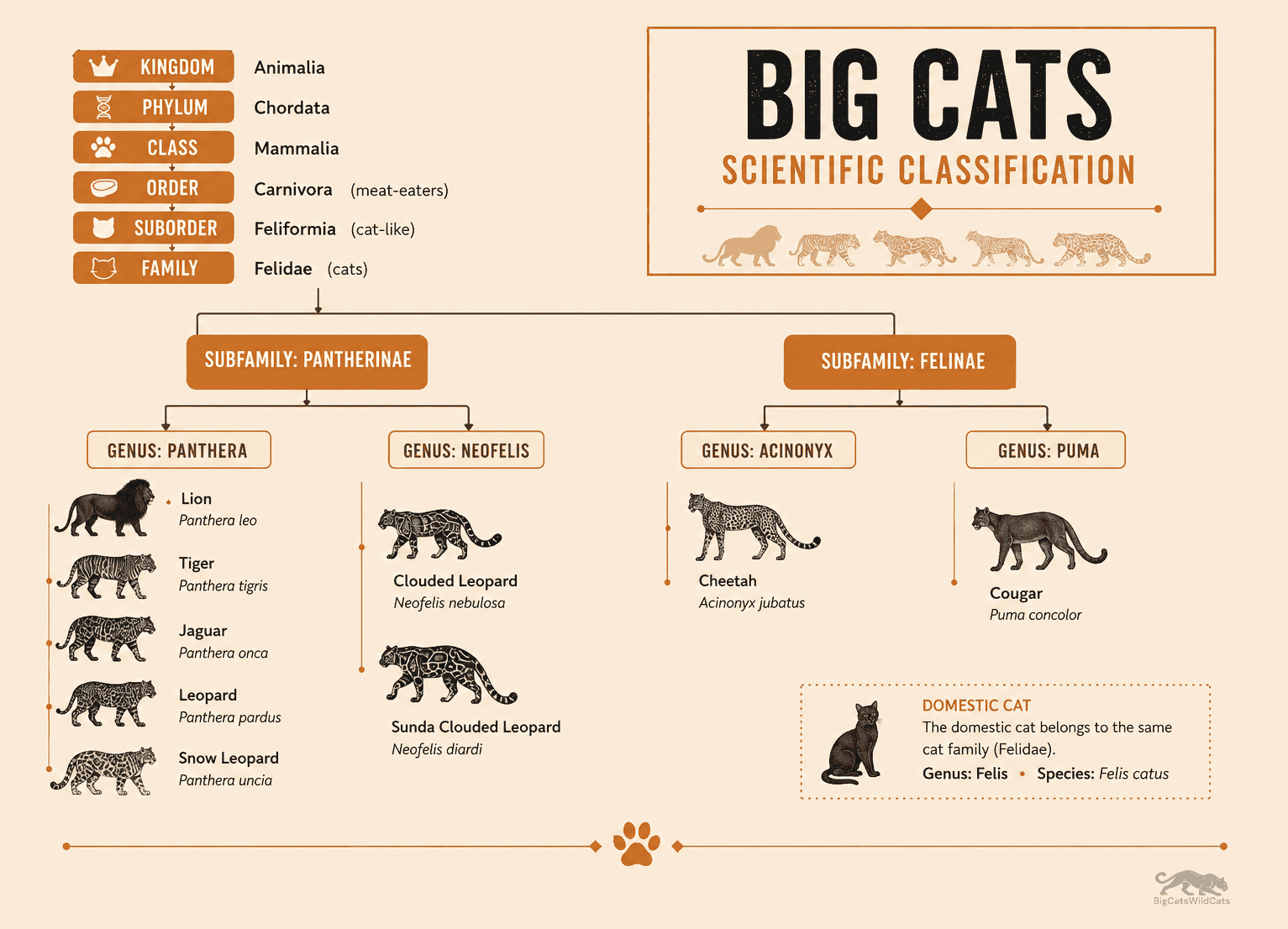
Using this classification, living big cats are members of:
- Kingdom: Animalia (multi-celled organisms that have nervous systems)
- Phylum: Chordata (groups having a similar body plan)
- Subphylum: Vertebrata (vertebrates – having a backbone or spinal column)
- Class: Mammalia (mammals – hair or fur, females produce milk for their young)
- Order: Carnivora (meat-eaters)
- Suborder: Feliformia (cat-like)
- Family: Felidae (cats)
- Subfamilies: Felinae and Pantherinae
The cats in the Felidae family are grouped into two subfamilies (Pantherinae and Felinae) and 14 genera. A genus (plural: genera) is a group with similar characteristics.
The Felidae Cat Family
The Felidae cat family members, which includes wild and domestic cats, are meat-eaters with retractable claws, muscular bodies, strong limbs, and powerful bites.
Other physical characteristics include:
- Large ears that, depending on the species, can be sensitive to high frequencies
- A variety of vocalizations
- Padded feet
- Five toes in the front and four in the back
- 30 teeth
- Large canine teeth
- Tongues with a rough texture
- Noses that extend beyond the lower jaw
- Extremely good to excellent night vision
- Stiff hair (whiskers) on their muzzle, cheeks, and above their eyes
Within the Felidae family, there are two subfamilies: Pantherinae and Felinae. It is believed that the Pantherinae and Felinae separated from a common ancestor around 11.5 million years ago.
You can find big cats in both subfamilies.
The Pantherinae Subfamily
Seven big cats are members of the Pantherinae subfamily: lions, tigers, jaguars, leopards (the big cats that roar), snow leopards, clouded leopards, and Sunda clouded leopards.
The subfamily Pantherinae has two genera, Panthera and Neofelis, with similar features and characteristics.
Lions, tigers, jaguars, leopards, and snow leopards are members of the Panthera genus.
Clouded leopards and Sunda clouded leopards are members of the Neofelis genus.
The Felinae Subfamily
Two big cats are members of the Felinae subfamily: cheetahs and cougars. The cheetah belongs to the Acinonyx genus, and the cougar belongs to the Puma genus.
What is a Genus?
A genus is a group of closely related species. There are 12 genera in the Felinae subfamily and two in the Pantherinae subfamily.
Big Cat Species
A species is an even smaller group of animals within a genus that can interbreed and produce offspring. Lions, tigers, jaguars, snow leopards, leopards, clouded leopards, Sunda clouded leopards, cheetahs, and cougars are all different species.
The table below shows how each big cat fits into its biological classification.
Big Cat Classification List
| Big Cat | Family | Subfamily | Genus | Species | Abbreviated |
| Lion | Felidae | Pantherinae | Panthera | Panthera leo | P. leo |
| Tiger | Felidae | Pantherinae | Panthera | Panthera tigris | P. tigris |
| Leopard | Felidae | Pantherinae | Panthera | Panthera pardus | P. pardus |
| Jaguar | Felidae | Pantherinae | Panthera | Panthera onca | P. onca |
| Clouded leopard | Felidae | Pantherinae | Neofelis | Neofelis nebulosa | N. nebulosa |
| Sunda clouded leopard | Felidae | Pantherinae | Neofelis | Neofelis diardi | N. diardi |
| Cheetah | Felidae | Felinae | Acinonyx | Acinonyx jubatus | A. jubatus |
| Cougar | Felidae | Felinae | Puma | Puma concolor | P. concolor |
More About Felid Taxonomy
Note: Identifying the evolutionary history of cats has been difficult. For many years, only hard-to-find fossils were being studied. However, the landscape of research has significantly changed with more recent techniques. DNA testing, in particular, has played a crucial role in establishing the felid time track.
The Feliformia is a suborder of cat-like carnivores. Along with the Caniformia (dog-like carnivores), they came into existence about 51 (or possibly longer) to 35 million years ago.
The Felidae family of cats began evolving around 25 million years ago, and possibly longer.
- The earliest known Felidae family ancestors were the Proailurus and Pseudaelurus. They first appeared in Asia and then spread to other continents.
- Proailurus is the oldest known cat. It appeared around 25 to 34 million years ago and lived in Europe and Asia. It was a small animal weighing around 20 lbs. and a little larger than a house cat.
- Pseudaelurus lived about 20 to possibly 9 million years ago in Europe and Asia and migrated to North America around 18.5 million years ago.
Big Cat Lineages
According to DNA and fossil analysis conducted in 2006, today’s modern cats are descended from one of several species of Pseudaelurus that lived in Asia around 11 million years ago.
The researchers also identified eight lineages of Felidae, and when each lineage diverged (separated). The first lineage, Panthera, separated from the Pseudaelurus around 10.8 million years ago, followed by the Bay cat lineage and Caracal lineage. The remaining five lineages (the Ocelot, Lynx, Puma, Leopard Cat, and Domestic Cat) evolved in North America.
| Big Cat | Family | Subfamily | Genus | Species | Abbreviated |
|---|---|---|---|---|---|
| Lion | Felidae | Pantherinae | Panthera | Panthera leo | P. leo |
| Tiger | Felidae | Pantherinae | Panthera | Panthera tigris | P. tigris |
| Leopard | Felidae | Pantherinae | Panthera | Panthera pardus | P. pardus |
| Jaguar | Felidae | Pantherinae | Panthera | Panthera onca | P. onca |
| Clouded Leopard | Felidae | Pantherinae | Neofelis | Neofelis nebulosa | N. nebulosa |
| Sunda Clouded Leopard | Felidae | Pantherinae | Neofelis | Neofelis diardi | N. diardi |
| Cheetah | Felidae | Felinae | Acinonyx | Acinonyx jubatus | A. jubatus |
| Cougar | Felidae | Felinae | Puma | Puma concolor | P. concolor |
Roaring vs. Non-Roaring Big Cats
Big cats are often grouped by whether they can roar, but this ability is not just about size—it is related to anatomy and classification.
Most members of the Panthera genus, including lions, tigers, jaguars, and leopards, can roar. This is made possible by a specialized structure in the throat. Their hyoid bone, which supports the tongue and larynx, is only partially ossified (not fully hardened). This allows the larynx to stretch and produce deep, powerful vocalizations.
However, not all cats in the Panthera genus can roar. The snow leopard is an exception. Even though it belongs to Panthera, its vocal anatomy is different, and it cannot produce a true roar. Instead, it makes sounds such as chuffing, growling, and yowling.
Cats in the Felinae subfamily, including cougars and cheetahs, also cannot roar. Their hyoid bones are fully ossified, which limits their ability to produce deep roaring sounds. Instead, they communicate through purring, chirping, hissing, and other vocalizations.
This distinction helps explain why the term “big cat” can be confusing. While roaring is often associated with big cats, it does not perfectly match scientific classification. Some large cats cannot roar, and classification is based on evolutionary relationships rather than vocal ability.
Reference & Quotes
“…a revolution in sequencing the genomes of various creatures, spearheaded by the Human Genome Project and by powerful technologies to probe DNA, has provided some extremely valuable new tools for inquiry…The comparison of gene sequences identified the lineages, the order of their emergence and, with the help of fossil calibrations, the time they appeared.”- 2007 The Evolution of Cats | Scientific American | O’Brien, Johnson et al.
Big cat classification brings structure to a group of animals that are often defined by size or appearance. By organizing species into families, subfamilies, genera, and species, scientists can better understand how these cats are related, how they evolved, and how they differ from one another. It also helps explain why some large cats, like cheetahs and cougars, are not part of the same lineage as lions and tigers. Looking at big cats through the lens of classification gives a clearer picture of their diversity—and why each species plays a unique role in the natural world.