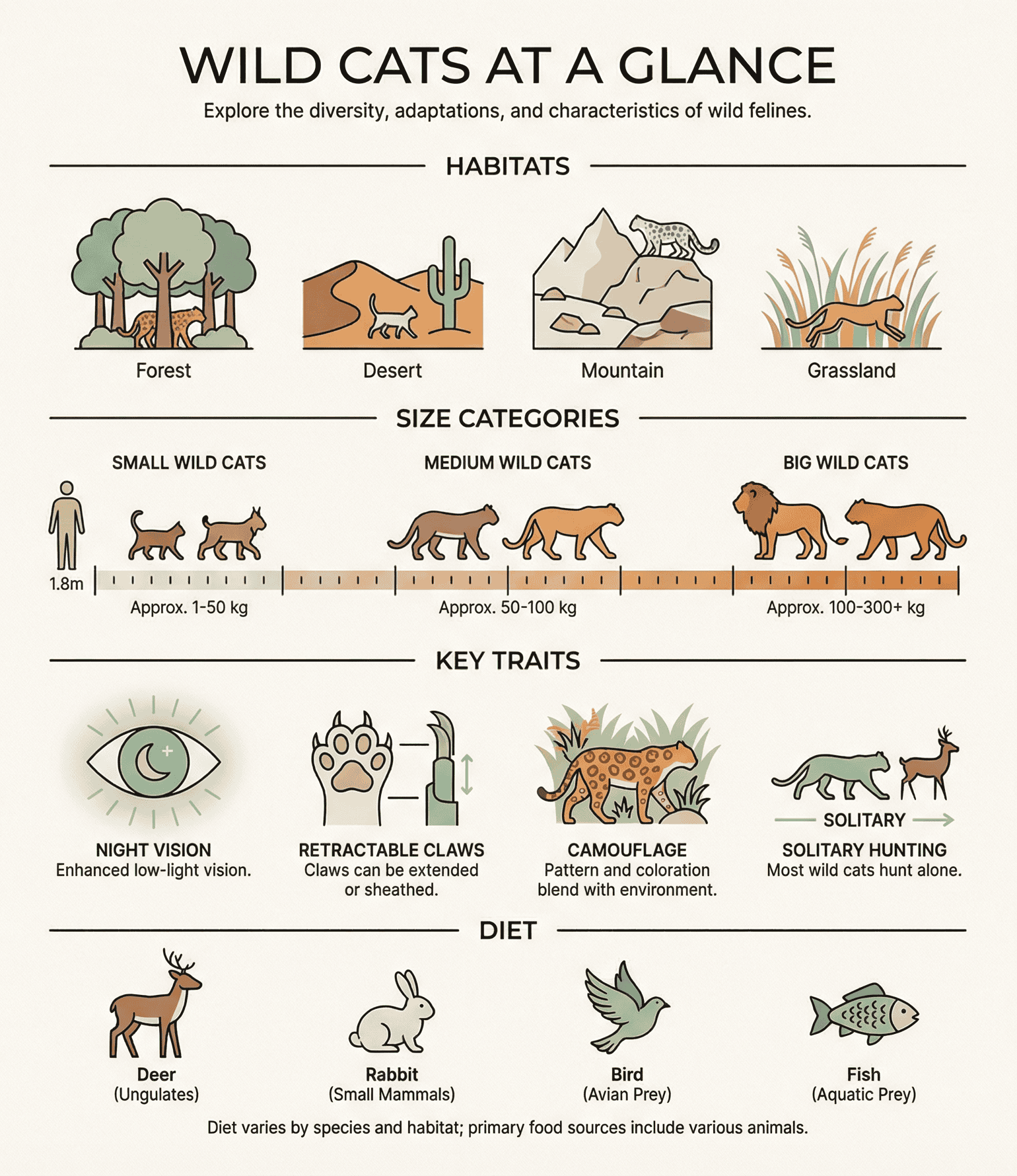
Wild cats are members of the Felidae family, a scientific classification. The Felidae family includes all wild cat species, as well as domestic cats. Wild cats are found all over the world, from forests and mountains to deserts and grasslands. Some are large and well known, like lions and tigers. Others are small and rarely seen, living in remote habitats.
What Is a Wild Cat?
A wild cat is any cat that lives and survives on its own in nature. Unlike domestic cats, wild cats are not dependent on humans for food or shelter.
Wild cats are often grouped by size:
- Big cats (like lions and tigers)
- Medium-sized cats (like lynx, caracals, and clouded leopards)
- Small wild cats (like sand cats and rusty-spotted cats)
All of them belong to the same family, but they have adapted to very different environments.
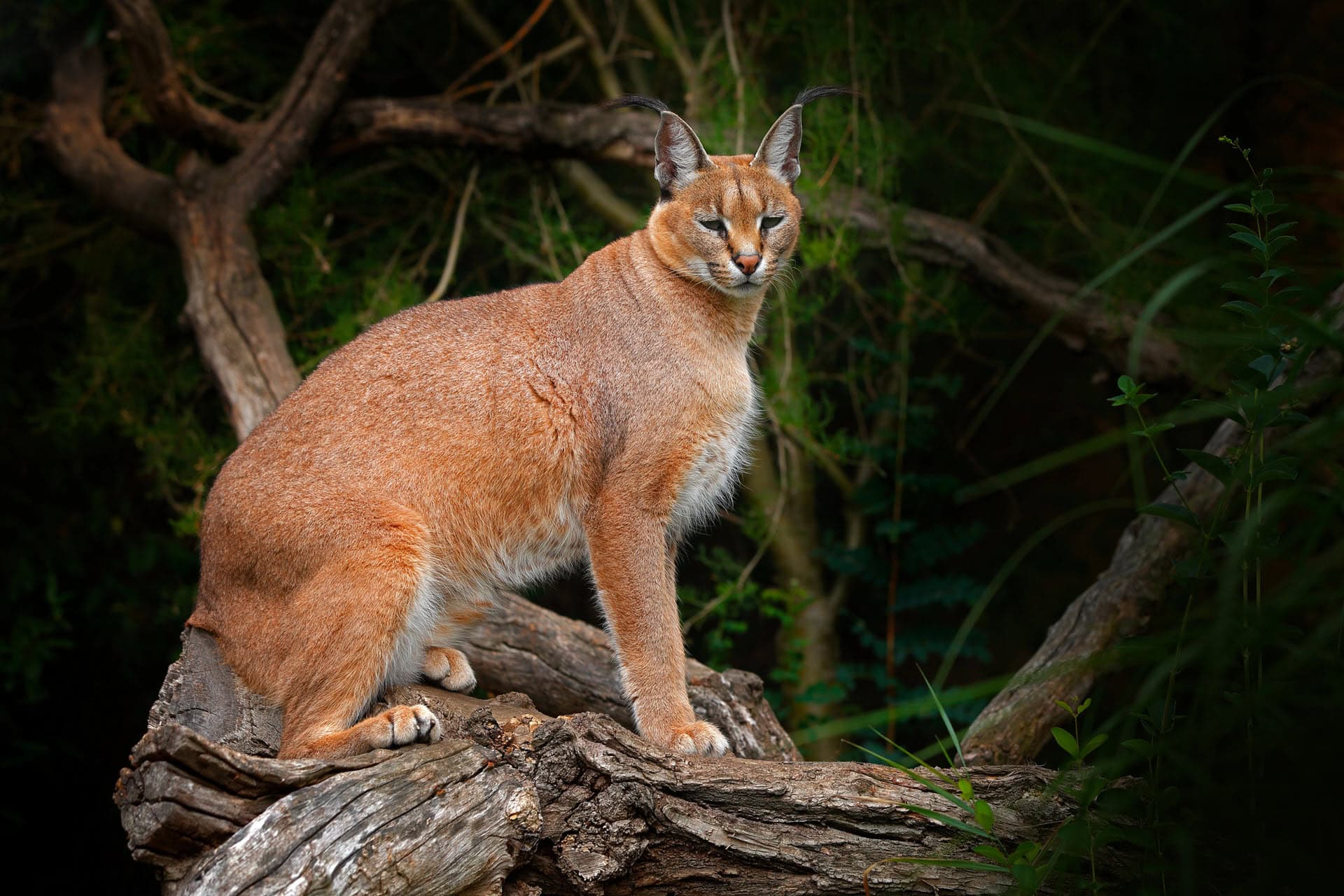
Image: The caracal is a medium-sized wild cat.
Interesting Facts About Wild Cats
Wild cats have some unique characteristics and abilities.
- Wild cats are built for short bursts of speed, not endurance.
Unlike wolves or wild dogs, which can run long distances, most cats rely on quick, powerful sprints to catch their prey. - Many wild cats hunt alone.
While animals like wolves and lions (an exception among cats) hunt in groups, most wild cats depend on stealth and surprise rather than teamwork. - Cats have retractable claws.
This means they can pull their claws back when not in use, keeping them sharp. Most other predators, like dogs, do not have this ability. - Their eyes are adapted for low light.
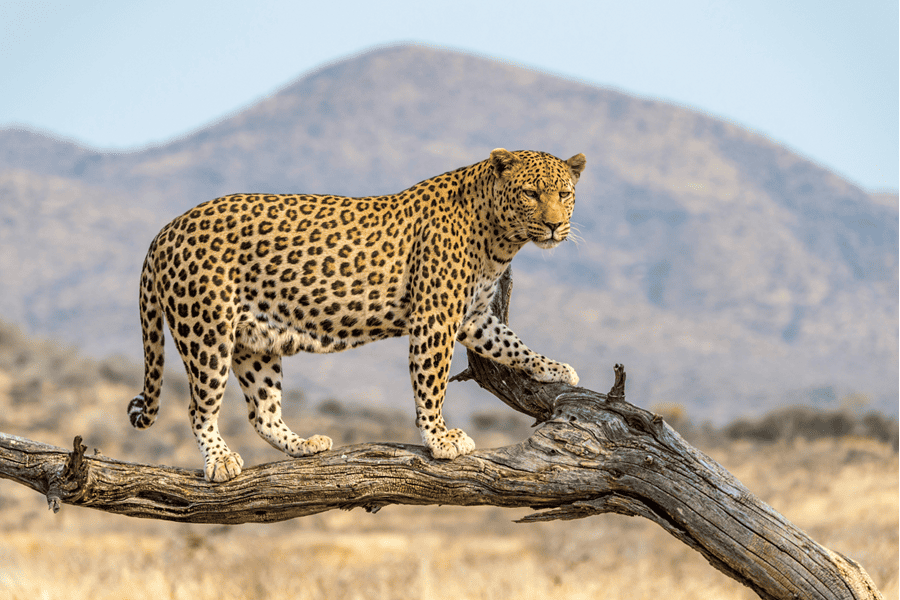
Wild cats can see much better at night than humans, which allows many species to hunt at dawn, dusk, or in darkness. - Every coat pattern has a purpose. Spots, stripes, and rosettes (rose-shaped markings) help cats blend into their environment, whether that’s tall grass, forest shadows, or rocky terrain.
Types of Wild Cats
Wild cats belong to the Felidae family, also called felids.
This family is divided into two main groups:
- Pantherinae – the larger cats, many of which can roar
- Felinae – medium and small cats, most of which cannot roar
A genus is a group of closely related species. The Felidae family includes multiple genera, each with its own set of cats.
You can explore classification and how these groups are organized in more detail on the Wild Cat Classification page.
______________________________
The family Felidae is one of the most specialized carnivore families, with all species sharing a similar body plan adapted for hunting.” – Source: Smithsonian Institution / Kitchener et al., 2017
______________________________
Where Wild Cats Live
Wild cats live on every continent except Antarctica.
They are found in:
- Africa – lions, leopards, cheetahs, servals
- Asia – tigers, snow leopards, jungle cats, leopard cats
- Europe – Eurasian lynx and wildcats
- North America – cougars, bobcats, Canada lynx
- Central and South America – jaguars, ocelots, margays, and many smaller species
Each species is adapted to its environment. Some prefer forests, others deserts, wetlands, or mountains.
How Wild Cats Evolved
Wild cats have been on this planet for millions of years. Early cat-like animals appeared long before the species we know today.
Over time, many of these early cats went extinct as climates changed and environments shifted. But some groups survived and continued to evolve.
Scientists believe that modern wild cats developed from a common ancestor called Pseudaleurus, which lived in Asia around 11 million years ago. From there, different groups of cats spread into new regions.
As sea levels rose and fell, land bridges formed between continents. This allowed cats to move into Africa, Europe, and the Americas. As they settled in different environments, they adapted and gradually became the different species we see today.
At some point, one branch of these cats followed a very different path.
Instead of remaining fully wild, a small group of cats began living near human settlements. These cats were drawn to areas where rodents were common, such as farms and early villages.
Over time, a relationship developed. Humans benefited from cats controlling pests, and the cats benefited from a steady food source. This process is known as domestication.
A domestic cat is a cat that has adapted to living alongside humans. Unlike wild cats, domestic cats depend on people for food, shelter, and care, even though many still retain strong hunting instincts.
While domestic cats became part of human life, the rest of the cat family continued to spread and evolve in the wild. These wild cats adapted to forests, deserts, mountains, and grasslands across the world.
Today, all cats—wild and domestic—are part of the same family, Felidae. They share a common ancestry, even though they now live very different lives.
Physical Features
Wild cats have muscular bodies and fur that vary in thickness depending on where the cat lives.
Different species also have different fur colors, including white, beige, light brown and golden brown, orange-brown, reddish-brown, and black. The fur is often spotted, striped, or marked with rosettes (a rose-shaped patch of color).
The cats range in size from small (around 2-3 lbs.) to large (over 600 lbs.).
The tiger is the largest wild cat, while species like the rusty-spotted cat are among the smallest.
Other characteristics include:
- Whiskers on their cheeks, above their eyes and muzzle – the protruding part of their face.
- Large eyes with excellent vision and a wide field of view.
- A tongue covered with a rough texture that makes it easier to groom and scrape meat from their prey.
- Five toes on their front feet and four on their back feet.
- The ability to lengthen or extend their claws (protractible claws). With some species, like the cheetah, the claws can be seen even when the cat is relaxed or resting.
- Like cats in general, most wild cats have around 30 teeth.
- Excellent night vision, sensitive ears, and an acute sense of smell.
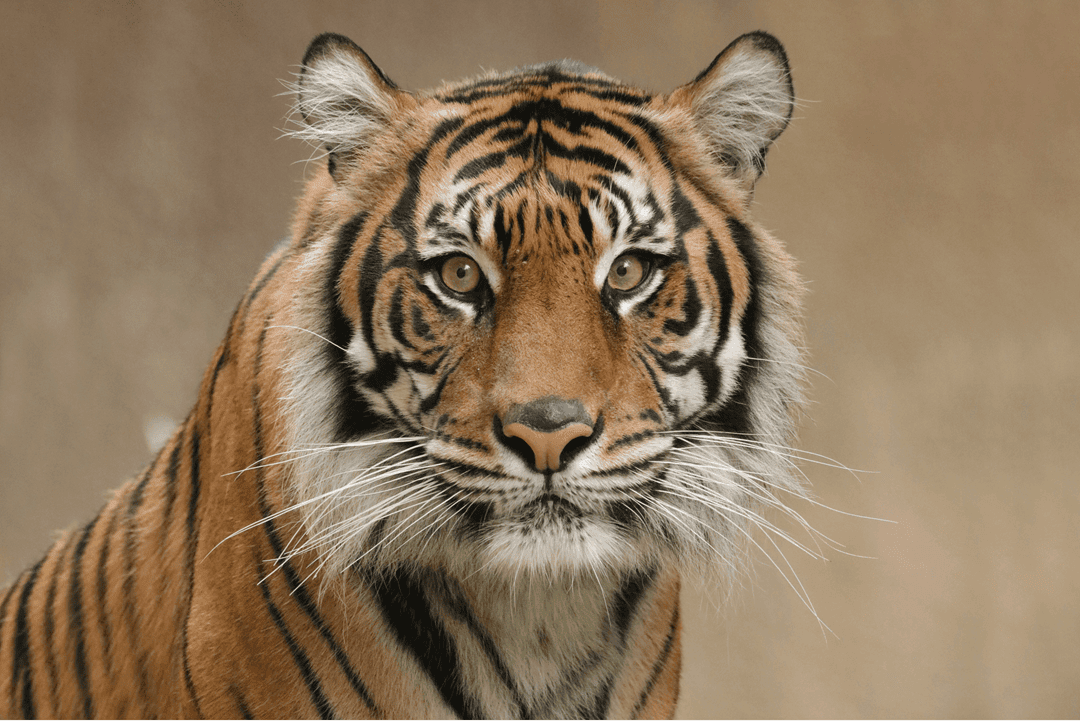
Image: Wild cats, like this tiger, have whiskers like domestic cats.
Behavior
Most wild cats are solitary, meaning they live and hunt alone. Lions are a well-known exception and live in groups called prides.
Wild cats are hunters. They rely on:
- Stealth (moving quietly)
- Strength
- Quick bursts of speed
Some species have specialized skills:
- Tigers and fishing cats are strong swimmers
- Leopards and margays are skilled climbers
- Cheetahs are built for speed
Wild cats communicate using sounds like:
- Growls, hisses, and snarls
- Purring and chirping
- Roaring (in some larger species)
What Wild Cats Eat
Wild cats are carnivores, which means they eat meat.
Their diet depends on where they live and what prey is available. This can include:
- Deer, antelope, and wild pigs
- Small mammals like rabbits and rodents
- Birds, reptiles, and fish
Some larger cats can take down very large prey, while smaller cats focus on smaller animals.
Reproduction and Life Cycle
Wild cats follow a similar life cycle, although details can vary by species.
Most wild cats reproduce through mating, where a male and female come together for a short period of time. After mating, the female raises the young on her own.
A female wild cat gives birth to a group of young called kittens. These kittens are born blind and helpless, and they depend completely on their mother for warmth, protection, and food.
As the kittens grow:
- their eyes open after a short time
- they begin to move around and explore
- they learn to hunt by watching and practicing
The mother teaches them how to survive, including:
- stalking and hunting prey
- avoiding danger
- understanding their environment
Most young cats stay with their mother for several months to over a year, depending on the species. After that, they leave to establish their own territory.
This stage is called independence, when a young animal begins to live on its own.
In the wild, many cats live around 10 to 15 years, although this can vary. Some may live longer in protected environments or captivity.
Wild Cat Conservation
Many wild cat species are now facing serious challenges in the wild.
As human populations grow, natural habitats are being reduced or divided. Forests are cleared, grasslands are developed, and roads cut through areas that wild cats once used freely. This makes it harder for them to find food, raise young, and move safely across their range.
Some of the biggest threats to wild cats include:
- Habitat loss – land is changed for farming, cities, and development
- Poaching – illegal hunting for fur, body parts, or trade
- Human-wildlife conflict – cats may be killed when they come into contact with livestock or people
- Declining prey populations – fewer animals to hunt
Not all wild cats face the same level of risk. Some species are still relatively stable, while others are endangered or critically endangered.
Conservation efforts are focused on:
- protecting habitats
- reducing conflict between humans and wildlife
- enforcing laws against illegal hunting and trade
- supporting research and monitoring
Wild cats play an important role in keeping ecosystems balanced. As predators, they help control animal populations and maintain healthy environments.
Learning about wild cats is one step toward understanding why they need protection.
You can explore these topics in more detail in the Conservation section.
How Wild Cats Help the Environment
Wild cats play an important role in their ecosystems.
As predators, they help control animal populations and keep ecosystems balanced. Without them, prey populations can grow too large and damage the environment.
Many wild cat species are now threatened by:
- Habitat loss
- Poaching
- Human-wildlife conflict
Learning about wild cats is one step toward understanding why they need protection.