Wild cats (family Felidae) have been evolving for millions of years. Today, they live on every continent except Antarctica, from dense forests to open deserts. But they all trace back to a small group of early ancestors that lived long before modern ecosystems took shape.
Understanding the history of wild cats helps explain why they look and behave the way they do today.
Early Ancestors
The earliest relatives of modern cats appeared around 25 million years ago. These early carnivores were small, agile, and likely spent much of their time in trees.
They were not yet the specialized hunters we recognize today. Instead, they were:
- Generalized predators
- Adapted to climbing and ambush
- Living in forested environments
Over time, these early forms began to develop the traits that define cats today:
- Retractable claws
- Sharp, slicing teeth
- Flexible bodies built for stealth
- Enhanced vision and hearing
______________________________
“Felidae originated in Europe by the end of the Eocene or beginning of the Oligocene.” – Source: Phylogeny and Evolution of Cats (Felidae) — based on fossil and molecular research.
______________________________
The Rise of Modern Cats
As environments changed, early cats began to diversify. This led to the emergence of the modern cat family, with different groups adapting to different conditions.
These groups eventually formed the major lineages of cats we recognize today.
- Some evolved into larger, powerful hunters
- Others remained small, agile, and highly specialized
- Each lineage developed its own hunting style and physical traits
Spreading Across the World
Cats did not stay in one place. Over millions of years, they expanded into new regions as land connections appeared between continents.
Key migration routes included:
- The Bering Land Bridge
- The Isthmus of Panama
- The Sinai Peninsula
These routes allowed cats to:
- Move into new continents
- Encounter new environments
- Evolve into new species
The Modern Era
Today, wild cats range from small species weighing just a few pounds to large predators like lions and tigers.
However, their history is now shaped by human activity:
- Habitat loss
- Fragmentation of populations
- Declines in prey species
Some species have adapted to living near humans, while others are increasingly rare.
How Cats Became Domesticated
Cats began to be domesticated around 9,000–10,000 years ago in the Middle East, in a region known as the Fertile Crescent. The species involved was the African wildcat.
Unlike many other domesticated animals, cats were not intentionally bred or controlled by humans at the start. Instead, domestication happened gradually as wildcats were drawn to early farming communities.
How it happened
As humans began to farm and store grain, they created a new ecological opportunity:
- Stored crops attracted rodents
- Rodents attracted wildcats
- Wildcats that stayed near people had reliable access to food
Some African wildcats were naturally less fearful and more tolerant of human presence. These individuals were more likely to remain near settlements and pass on those traits.
Over time, this led to a population of cats that lived alongside humans without being fully wild.
Where it happened
This process began in the Fertile Crescent, an area that includes parts of modern-day:
- Iraq
- Syria
- Israel
- Turkey
Early agricultural villages in this region created the conditions that allowed cats and humans to interact regularly.
Why these cats were domesticated
Only certain cats were suited to this process. The African wildcat had key traits that made domestication possible:
- Adaptable to open and human-altered environments
- Able to hunt rodents efficiently
- Less aggressive than many other wild cat species
- Tolerant of living near humans
Other wild cats did not share this combination of traits. Many were:
- too specialized in their habitats
- more territorial or aggressive
- less able to live near human activity
As a result, domestication happened in only one lineage.
A gradual relationship
This was not a sudden change. It took thousands of years for wildcats living near humans to become what we now recognize as domestic cats.
Even today, domestic cats retain many of the behaviors of their wild ancestors, reflecting this unique and gradual path to domestication.
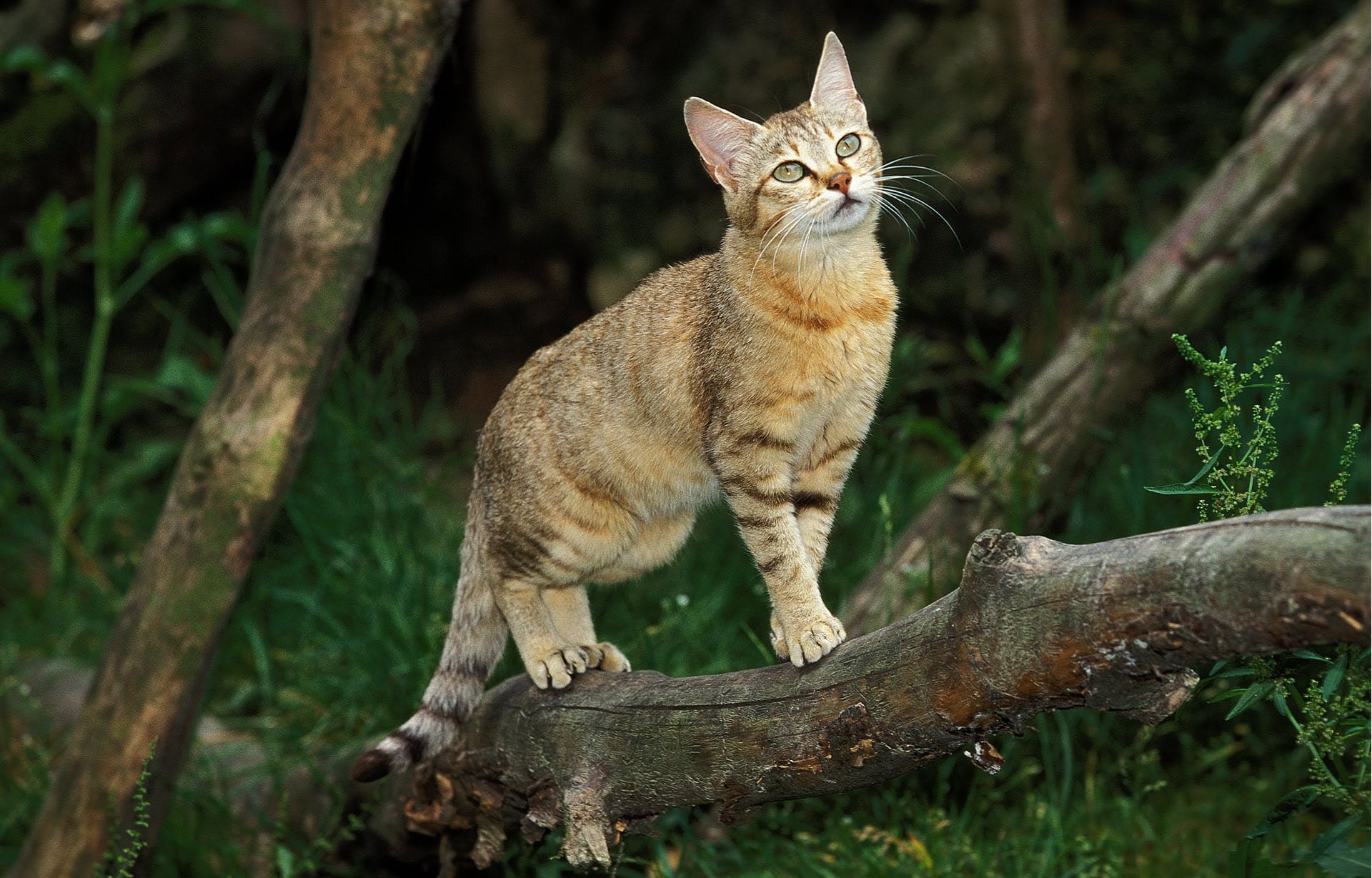
Image: The African wildcat was domesticated in the Middle East.
Adapting to Different Environments
As cats spread across the world, they adapted to very different habitats.
Some examples:
- Forest cats developed strong climbing ability and camouflage
- Open-land cats evolved speed and long legs for chasing prey
- Desert cats adapted to heat, sand, and limited water
Despite these differences, all cats share the same core traits:
- Stealth
- Precision
- Short bursts of power
These shared traits reflect their common ancestry.
Why This History is Important
The history of wild cats is not just about the past. It explains:
- Why different species look and behave differently
- How cats spread across the world
- Why some species are more vulnerable today
By understanding their history, we can better understand the role wild cats play in ecosystems—and why protecting them is important.