Early research into the evolution of the cat family (Felidae) relied heavily on fossil evidence, which is often incomplete and difficult to interpret. More recent advances in DNA analysis have allowed scientists to better understand how modern cat species are related and how they evolved over time.
In 2006, a genetic study analyzing DNA from 38 cat species identified eight major lineages. Each lineage represents a group of closely related species that share a common ancestor and similar characteristics.
The oldest of these lineages is associated with the Pantherinae subfamily, which includes the largest cats.
| Lineage | Divergence (Million Years Ago) | First Ancestor Appeared |
|---|---|---|
| Panthera | 10.8 Mya | 6.4 Mya |
| Bay Cat | 9.4 Mya | 5.41 Mya |
| Caracal | 8.5 Mya | 5.6 Mya |
| Ocelot | 8 Mya | 2.9 Mya |
| Lynx | 7.2 Mya | 3.2 Mya |
| Puma | 6.7 Mya | 4.9 Mya |
| Asian Leopard Cat | 6.2 Mya | 5.9 Mya |
| Domestic Cat (Felis) | 3.4 Mya | 3.4 Mya |
Wild Cat Ancestors
The suborder Feliformia split into several families approximately 35 to 50 million years ago. The modern cat family (Felidae) emerged around 25 million years ago, beginning with early genera such as Proailurus and Pseudaelurus.
Pseudaelurus appeared after Proailurus and lived in Asia, Europe, and North America approximately 8 to 20 million years ago. It is considered the last common ancestor of today’s cat lineages.
From this ancestor, the two major subfamilies—Felinae and Pantherinae—developed, along with the eight modern cat lineages recognized today.
The First Three Lineages
Panthera Lineage
Timeline: The Panthera lineage is the oldest cat lineage. It diverged from Pseudaelurus around 10.8 million years ago.
Genera: Panthera, Neofelis
Species:
- (Panthera) lion, tiger, jaguar, leopard, snow leopard
- (Neofelis) clouded leopard, Sunda clouded leopard
Location: Africa, Asia, and the Americas
The Panthera lineage includes the largest living cats. Members of the Panthera genus—lion, tiger, leopard, jaguar, and snow leopard—are among the most powerful terrestrial predators. The clouded leopards (Neofelis) represent a more ancient branch of this lineage.
Shared characteristics of Panthera:
- Large, muscular bodies
- Broad skulls and powerful jaws
- Large paws and long tails
- A specialized larynx that allows most species to roar
- Ability to “chuff” (prusten), a low-intensity vocalization
Shared characteristics of Neofelis:
- Elongated skull and nasal structure
- Very long upper canine teeth
- Strong jaws adapted for gripping prey
Bay Cat Lineage
Timeline: The Bay Cat lineage diverged around 9.4 million years ago and is the oldest lineage within the Felinae subfamily.
Genera: Pardofelis, Catopuma
Species:
- Marbled cat (Pardofelis)
- Borneo bay cat (Catopuma)
- Asian golden cat (Catopuma)
Location: Southeast Asia
This lineage consists of three forest-dwelling cats found primarily in Southeast Asia. These species remained geographically isolated, contributing to their distinct evolutionary path.
The Asian golden cat and bay cat diverged from each other around 3.2 million years ago, while the marbled cat split earlier, around 5.5 million years ago.
Shared characteristics:
- Long tails
- Rounded ears
- Shorter heads
- Adaptations for forest environments
Caracal Lineage
Timeline: The Caracal lineage diverged around 8.5 million years ago.
Genera: Caracal, Leptailurus
Species:
- Caracal
- Serval
- African golden cat
Location: Primarily Africa, with some range into Asia
This lineage evolved from ancestors that migrated from Asia into Africa. The caracal later expanded its range back into parts of Asia.
Shared characteristics:
- Long legs and slender bodies
- Excellent jumping ability
- Adaptations for hunting in open environments
The North American Lineages
The formation of land bridges—especially during periods of lower sea levels—allowed early cats to migrate from Asia into North America. From there, several lineages evolved and later spread into South America and back into Eurasia.
Ocelot Lineage
Timeline: The Ocelot lineage likely evolved in North America around 8 million years ago.
Genus: Leopardus
Species include:
- Ocelot
- Margay
- Pampas cat
- Andean mountain cat
- Geoffroy’s cat
- Kodkod
- Oncilla (northern and southern tiger cats)
This lineage represents the oldest group of small wild cats in the Americas. Members later migrated into South America via land bridges approximately 2 to 3 million years ago.
Shared characteristics:
- Spotted or patterned coats
- Rounded ears with white markings
- Slender, agile bodies
- Cranial similarities in skull and jaw structure
Lynx lineage
Timeline: The Lynx lineage evolved around 7.2 million years ago.
Genus: Lynx
Species:
- Bobcat
- Canada lynx
- Eurasian lynx
- Iberian lynx
These medium-sized cats are well adapted to colder environments.
Shared characteristics:
- Tufted ears
- Thick fur
- Short tails
- Large paws for moving through snow
Puma lineage
Timeline: The Puma lineage appeared around 6.7 million years ago.
Genera: Puma, Acinonyx, Herpailurus
Species:
- Cougar (Puma)
- Cheetah (Acinonyx)
- Jaguarundi (Herpailurus)
This lineage is unusual because of the evolutionary history of the cheetah. Some studies suggest that cheetahs originated in North America and later migrated to Africa and Asia, while others propose a Eurasian origin.
Leopard cat lineage
Timeline: The Leopard cat lineage separated from its ancestors around 6.2 million years ago.
Genus: Otocolobus, Prionailurus
Species: (Otocolobus) Pallas’s cat, (Prionailurus) flat-headed cat, leopard cat, Sunda leopard cat, rusty-spotted cat, fishing cat
The members of the Leopard cat lineage also evolved from ancestors that migrated to North America, but crossed back to Asia during the second ice age. For example, the Asian leopard cat had a common ancestor with the bob cat about 8 million years ago.
Domestic cat lineage
Timeline: The Domestic cat lineage emerged around 3.4 million years ago, making it the most recent lineage.
Genus: Felis
Species:
- African wildcat
- European wildcat
- Jungle cat
- Sand cat
- Black-footed cat
- Chinese mountain cat
- Domestic cat
Members of this lineage are generally small to medium-sized cats. Most weigh under 10 pounds and are adapted to a variety of environments across Africa, Europe, and Asia.
Migration
The global distribution of cats was shaped by the formation of land bridges, which appeared when sea levels dropped.
These land bridges exposed sections of continental shelf and allowed animals to migrate between continents.
Key examples include:
- Bering Land Bridge – connected Asia and North America
- Isthmus of Panama – connected North and South America
- Sinai Peninsula – connected Africa and Eurasia
These connections enabled cats to expand their range, diversify, and evolve into the species seen today.
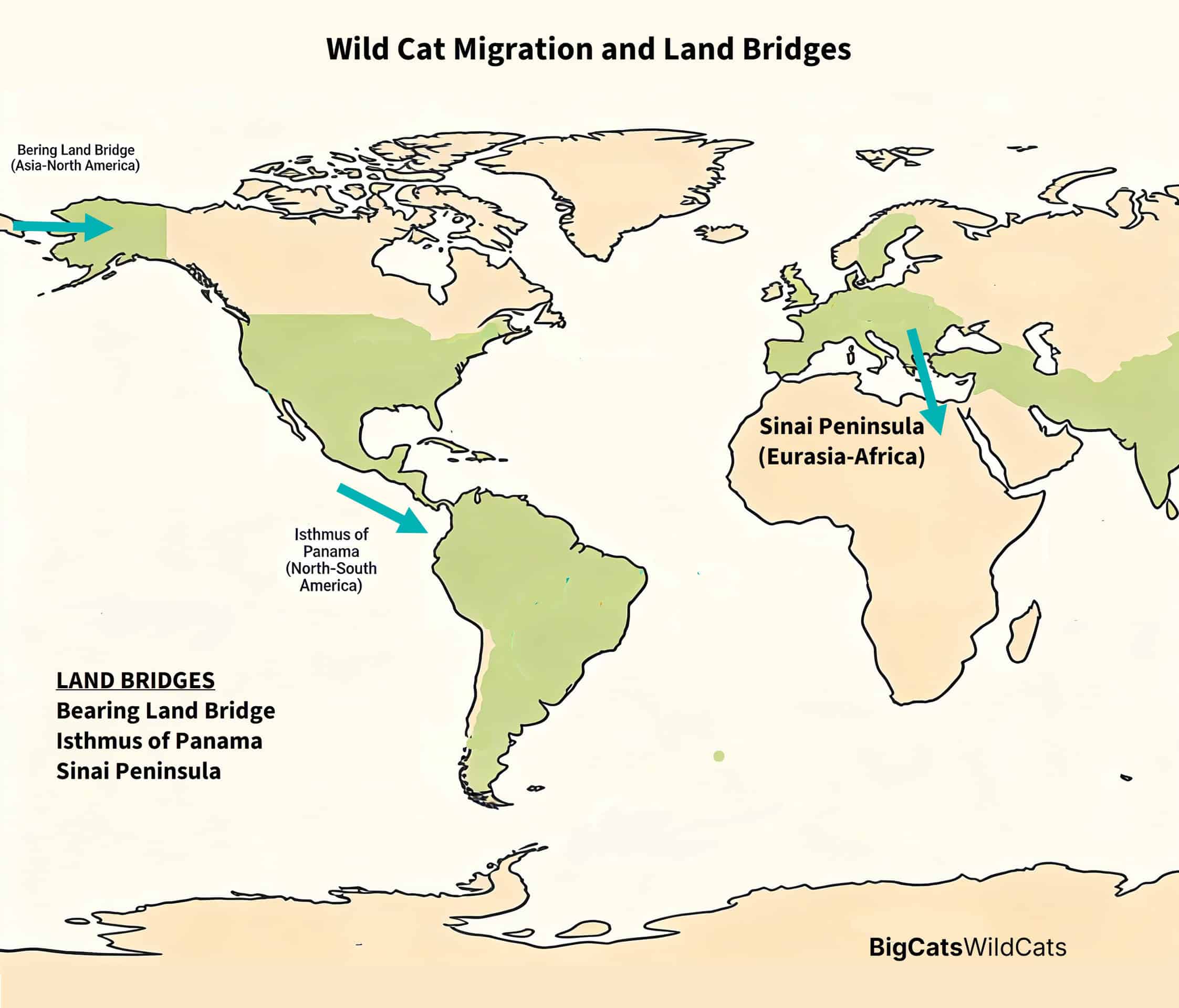
Wild cats (family Felidae) spread from Asia into North and South America and into Africa using ancient land connections.
References
1985 – A MOLECULAR PHYLOGENY OF THE FELIDAE: IMMUNOLOGICAL DISTANCE | Collier, O’Brien
2016 – Phylogenomic evidence for ancient hybridization in genomes of living cats (Felidae) | Li, Davis, et al.
2007 – The Evolution of Cats | O’Brien, J. S. and Johnson, W. E. | Scientific American July 2007: 68-75.