
What Do Lions Symbolize?
For thousands of years, lions have appeared in art, religion, mythology, architecture and royal symbols. Images of lions have guarded temples and tombs, represented kings and gods, appeared on coats of arms and become symbols of cities and nations.
Lion symbolism has changed between cultures and throughout history. However, certain ideas appear again and again. Lions have been used to represent strength, power, authority, courage and protection.
To understand why the lion became such a powerful symbol, it helps to begin with the history of lions themselves and their long relationship with humans.
Lion History and Early Human Culture
Lions have a long evolutionary history. The ancestors of modern lions evolved in Africa. By several hundred thousand years ago, lions and closely related lion populations had spread far beyond Africa into Europe and Asia. During the Ice Age, cave lions lived across much of Europe and northern Asia, while another lion population reached North America.
These ancient lions were not all identical to the African and Asian lions alive today. Some belonged to extinct populations or species, including the cave lion, which disappeared near the end of the last Ice Age.
Humans were living in some of these same regions. By at least 30,000–40,000 years ago, prehistoric people in Europe were depicting lions in their art.
Cave paintings show lions individually and in groups. Some images show lions walking, standing together or apparently hunting. Prehistoric people also carved lions from materials such as ivory.
One of the most extraordinary examples is the Lion Man of Hohlenstein-Stadel in Germany. Carved from mammoth ivory tens of thousands of years ago, the figure combines characteristics of a human and a cave lion.
We cannot know exactly what lions represented to the prehistoric people who created these images. They left no written explanations telling us whether lions represented strength, danger, spiritual beings or something entirely different.
What we can see is that people observed lions closely enough to reproduce their appearance and behavior and, in the case of the Lion Man, incorporated lion characteristics into imaginative or symbolic art. Lions had entered human culture long before written history began.
Over time, the ancient lion populations of Europe and North America disappeared. Modern lions survived across Africa and parts of the Middle East and Asia. As the first great civilizations developed, people in these regions continued to live in a world where lions were real and formidable predators.
Unlike prehistoric people, these later societies left written records, monuments and works of art that provide much more information about what lions meant to them. This is where the history of lion symbolism becomes much clearer.
Lion Symbolism Through History
The symbolism of the lion did not develop in one civilization. Different cultures gave lions meanings that reflected their own rulers, religions and traditions. Following these cultures through history shows how ideas about lions developed and how some of those meanings survived for thousands of years.
Lions in Ancient Egypt
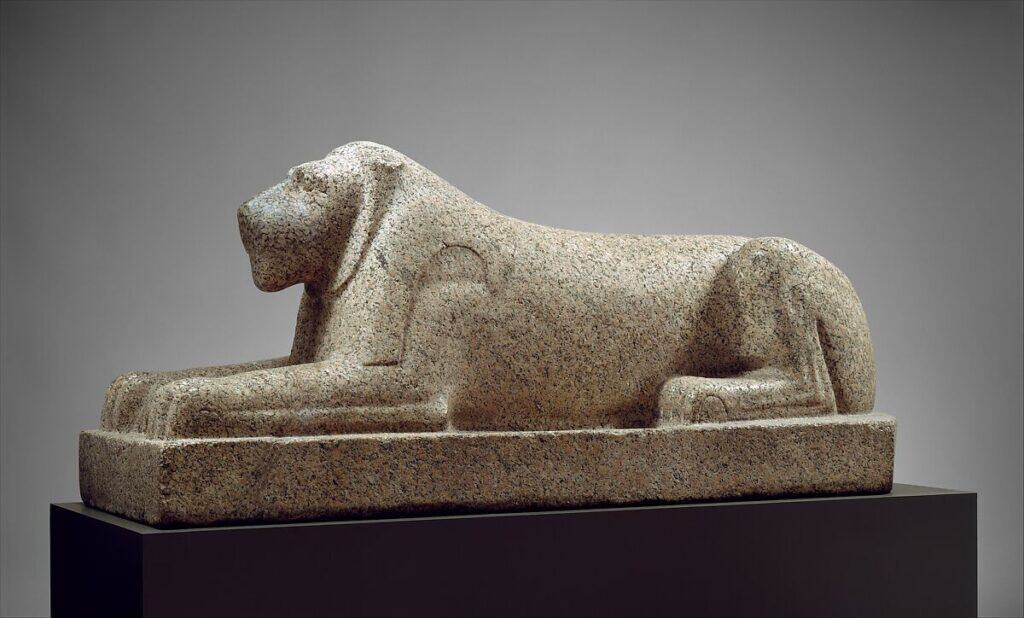
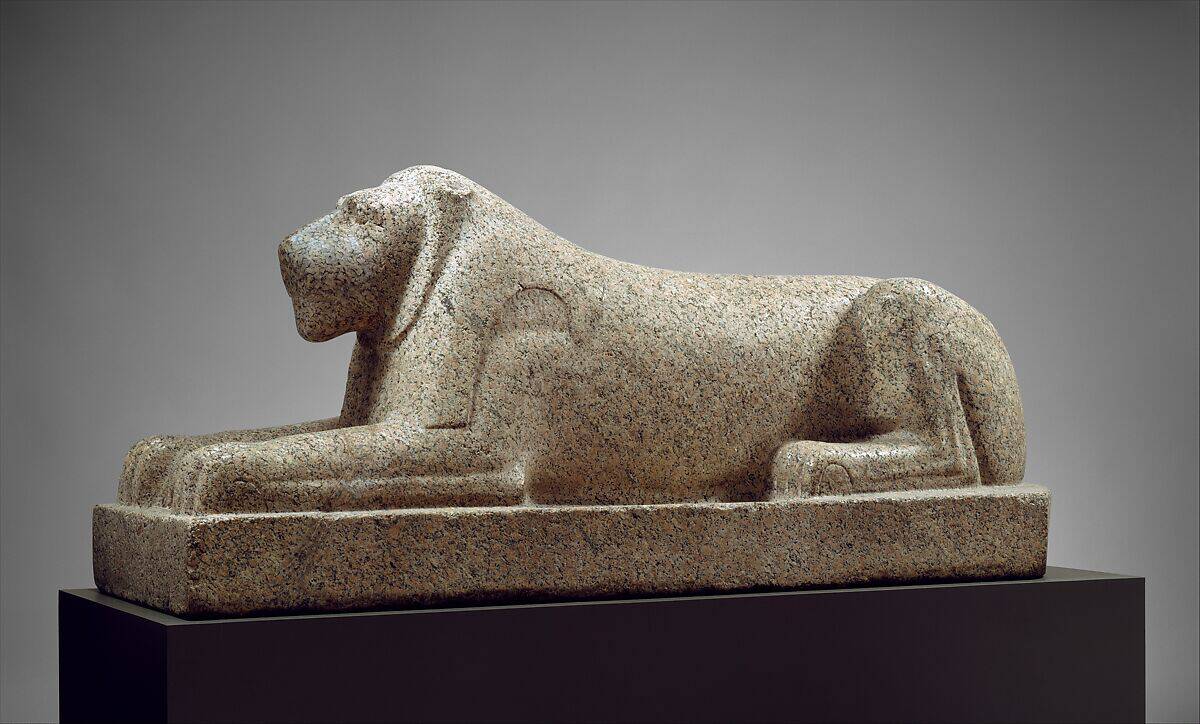
Image: Recumbent Lion, ca. 2575 -2450 BCE – The Met – Public Domain
Ancient Egypt was a civilization that developed along the Nile River in northeastern Africa and lasted for more than 3,000 years. Beginning around 3100 BCE, Egypt was ruled for much of its history by kings known as pharaohs. Egyptian society produced large cities, temples and monumental tombs, while religion and the authority of the pharaoh played major roles in Egyptian life.
In ancient Egypt, lions became closely connected with royal power, strength, protection and divine power.
This connection was rooted partly in the real animal. Lions once inhabited areas around the Nile Valley, and their position as powerful predators made them natural animals to associate with powerful rulers.
The association appeared very early in Egyptian history. A monumental granite lion dating to approximately 2575–2450 BCE once guarded the entrance to a sanctuary. The Metropolitan Museum of Art describes the lion as a symbol of royalty from an early period of Egyptian civilization.
The connection between lions and pharaohs became especially visible in the sphinx. The sphinx combined the body of a lion with the head of a human ruler, joining the physical power of the animal with the identity and authority of the king.
Lion imagery also had religious meanings. Sekhmet, one of Egypt’s best-known lioness-headed goddesses, was associated with war, violence and destructive power. Yet her power could also protect and heal. Her lioness form therefore represented a force that could be both dangerous and protective.
Ancient Egyptian lion symbolism was not based on a single idea. Royal authority, physical strength, divine power and protection were closely connected.
Lions in Ancient Mesopotamia
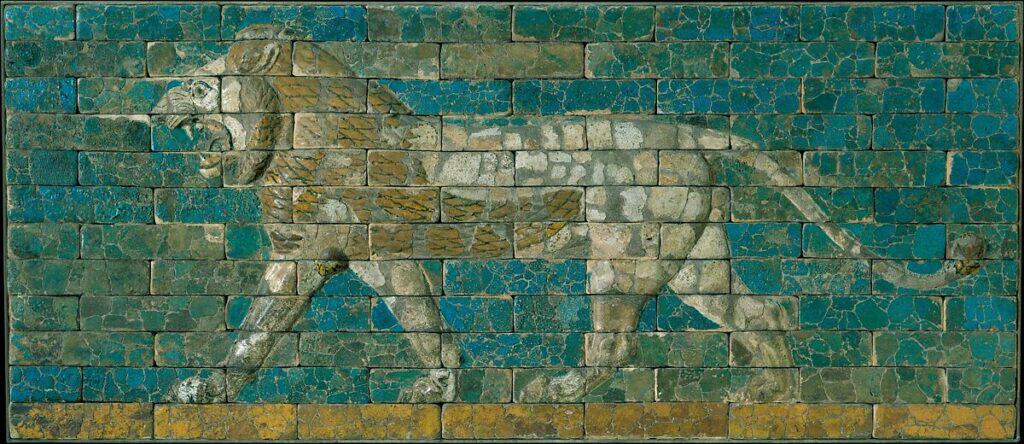
Image: Panel with striding lion, ca 604-562 BCE, The Met, Public Domain
Ancient Mesopotamia was a region of early civilizations that developed between and around the Tigris and Euphrates rivers, primarily in what is now Iraq. Beginning more than 5,000 years ago, the region was home to civilizations and empires including the Sumerians, Akkadians, Babylonians and Assyrians. Mesopotamia contained some of the world’s earliest cities and writing systems and became an important center of government, religion, trade and art.
Lions became important symbols in Mesopotamia, where they were associated with both rulers and gods.
Royal lion hunts became a particularly powerful image of kingship. A king confronting and defeating a lion could demonstrate his own strength and his ability to overcome a dangerous force. Some of the most famous surviving examples are the Assyrian reliefs depicting royal lion hunts.
Lions also had religious significance. They became associated with Ishtar, a major Mesopotamian goddess connected with love and war.
One of the most dramatic surviving examples comes from ancient Babylon. During the reign of Nebuchadnezzar II in the sixth century BCE, images of lions made from brightly glazed bricks lined the Processional Way through the city. Approximately 120 lions were represented along the route.
The lions were associated with Ishtar and formed part of the religious and ceremonial imagery surrounding the Processional Way.
In Mesopotamia, lions could therefore communicate several related ideas: royal strength, victory, divine power and protection.
Lions in Ancient Greece
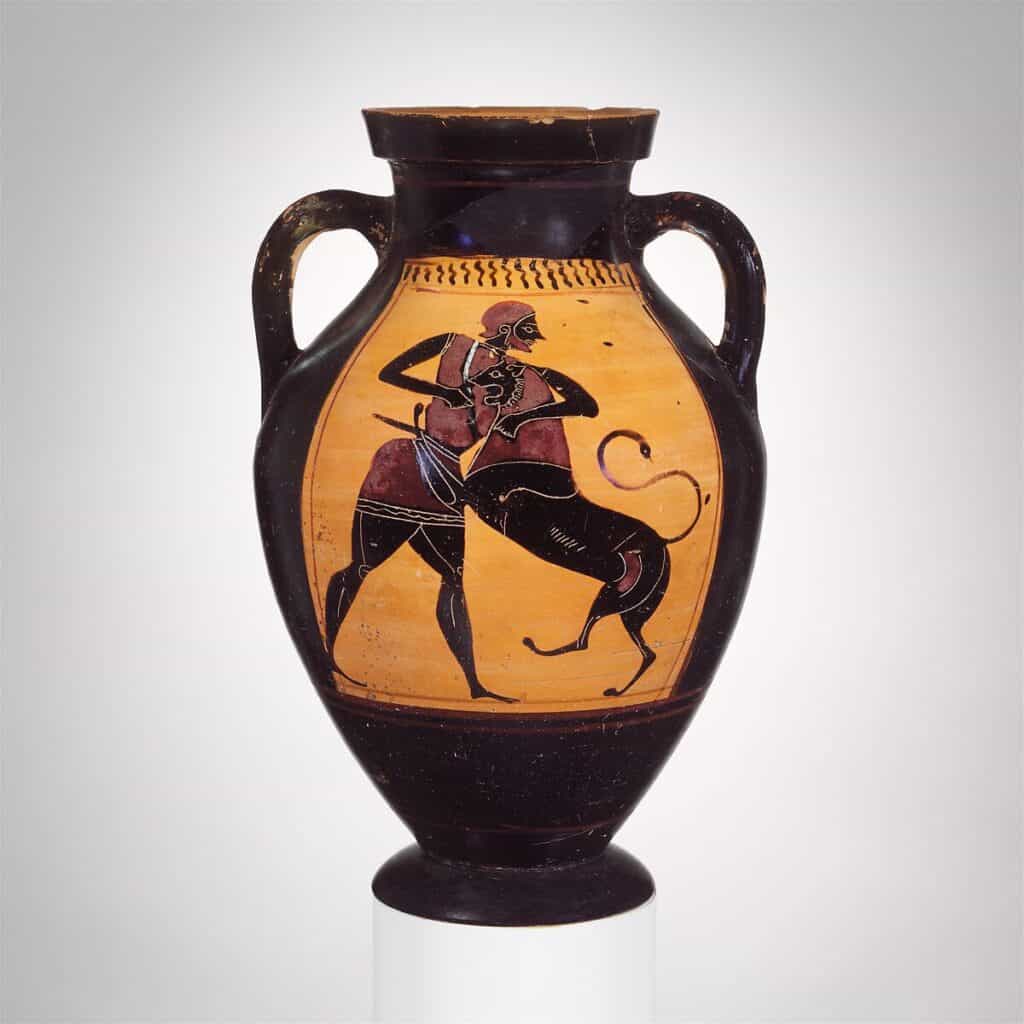
Image: Terracotta amphora (Jar), ca. 540 BCE , The Met, Public Domain
Ancient Greece developed around the Aegean and Mediterranean seas in southeastern Europe. Greek culture flourished particularly during the first millennium BCE, when communities were organized into independent city-states such as Athens and Sparta. Greek mythology, religion, literature, philosophy, art and political ideas had a lasting influence on later Mediterranean and European cultures.
Lions occupied an important place in Greek mythology and art, where they were frequently connected with extraordinary physical strength.
Perhaps the best-known example is the story of Heracles and the Nemean Lion. According to Greek mythology, Heracles was required to kill a formidable lion whose hide could not be pierced by ordinary weapons. After defeating the animal, he wore its skin.
The lion in the story was an opponent of extraordinary strength. Defeating such a powerful animal demonstrated the hero’s own exceptional strength and courage.
Lions also appeared in Greek sculpture, architecture, pottery and funerary monuments.
The Greek tradition helped reinforce an association that would remain important for centuries: the lion as a representation of strength, heroism and courage.
Lions in Ancient Persia
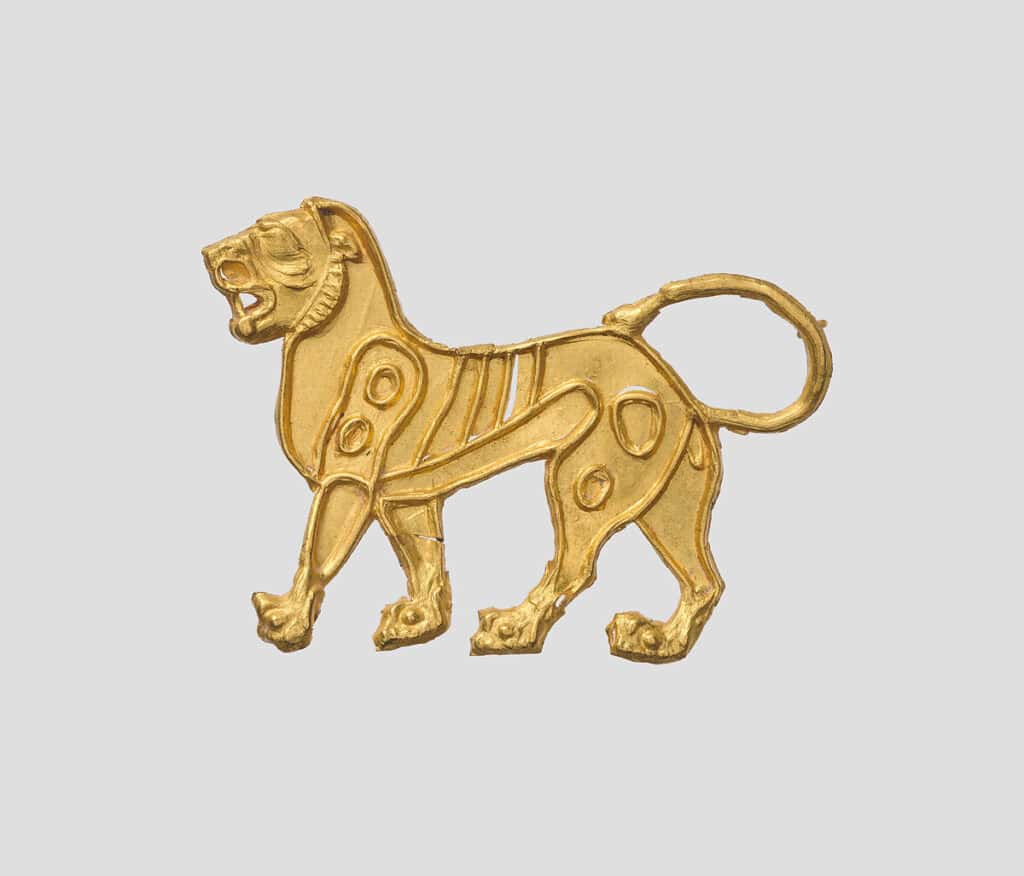
Image: Applique in the shape of a lion, ca. 6th-4th century BCE, The Met, Public Domain
Ancient Persia refers to civilizations and empires centered in the region of present-day Iran. One of the largest was the Achaemenid Persian Empire, founded in the sixth century BCE. At its height, the empire controlled an enormous territory extending from parts of Central and South Asia through the Middle East to Egypt and southeastern Europe. Persian rulers governed many different peoples and built major royal and ceremonial centers, including Persepolis.
Lions were prominent in Persian art and appeared in royal and ceremonial settings.
During the Achaemenid Empire, lion imagery could be seen at Persepolis, one of the empire’s great ceremonial centers.
Among the best-known images from Persepolis are reliefs showing a lion attacking a bull. Scholars have proposed different interpretations of these images, so they should not be assigned one definite symbolic meaning.
More broadly, however, lions formed part of the visual world surrounding Persian royalty and imperial power.
The lion continued to have an important place in Persian culture long after the Achaemenid period and eventually became part of one of Persia’s most recognizable historical emblems, the Lion and Sun.
Lions in Ancient India
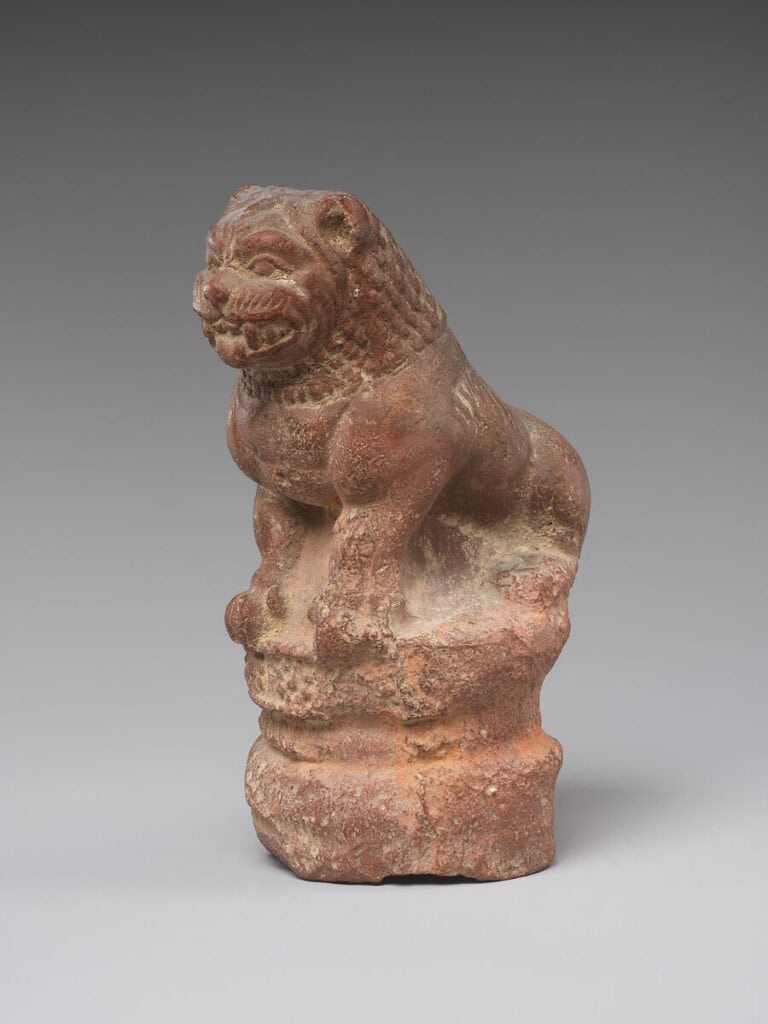
Image: Lion Standing on a Pillar Capital, ca 5th – 6th century, The Met, Public Domain
Ancient India refers broadly to the civilizations, kingdoms and empires that developed across the Indian subcontinent over thousands of years. The region was home to the Indus Valley Civilization beginning in the third millennium BCE and later to numerous kingdoms and empires. By the first millennium BCE, major religious and philosophical traditions including Hinduism, Buddhism and Jainism were developing or taking recognizable historical forms, while powerful states such as the Mauryan Empire united large areas of the subcontinent.
Lions developed important meanings in South Asian political and religious traditions. The Asiatic lion once occupied a much larger range than it does today, so people in parts of the region knew lions as real animals as well as symbolic ones.
One of the most important surviving examples comes from the reign of Emperor Ashoka of the Mauryan Empire in the third century BCE. Ashoka erected monumental stone pillars at important locations, several of which were topped by lions.
The most famous is the Lion Capital of Ashoka at Sarnath, which features four lions standing back-to-back.
The Lion Capital later became the basis of the national emblem of modern India, giving ancient lion imagery a continuing role in the country’s national identity.
Lions also appear in Hindu and Buddhist traditions. Their particular meaning varies according to the religious figure, story or setting in which they appear.
Across these traditions, lions became associated with ideas including authority, spiritual power and strength.
Lions in Ancient China
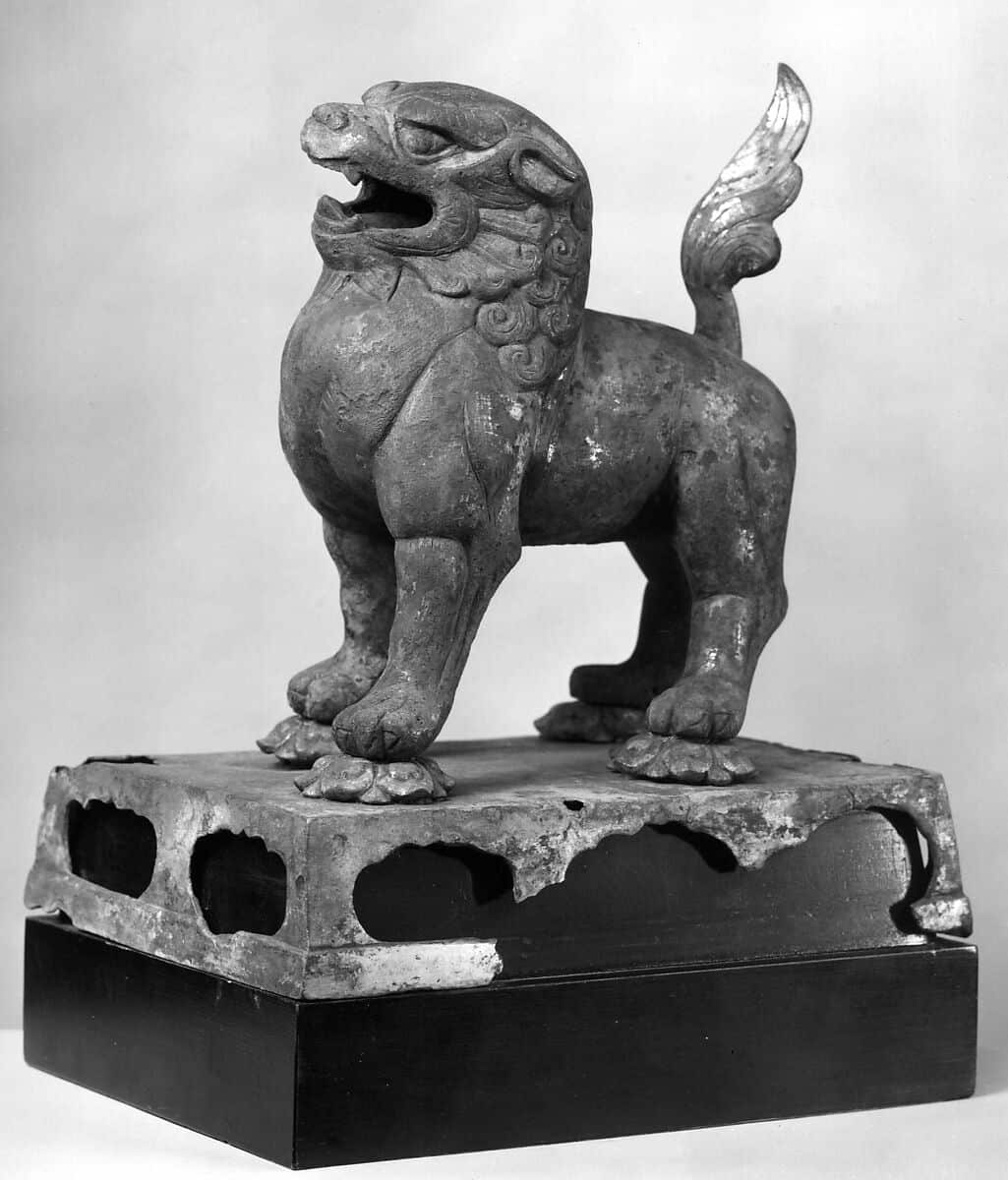
Image: Lion, 8th century, China, The Met, Public Domain
Ancient Chinese civilization developed around major river systems in East Asia, particularly the Yellow and Yangtze rivers. A succession of dynasties ruled different parts of China over thousands of years, including the Shang, Zhou, Qin and Han dynasties. By the Han dynasty, which ruled from 206 BCE to 220 CE, China had developed a large centralized empire with extensive trade and diplomatic connections to Central Asia and regions farther west.
The history of lion symbolism in China developed differently because lions are not native to China.
Knowledge of actual lions reached China through contact with regions to the west. By the Han period, lions were known at the imperial court, and lion imagery became increasingly familiar.
Buddhism played an especially important role in the development of Chinese lion imagery. As Buddhism became established in China, lions became associated with the protection of Buddhist teachings and sacred places.
Lions also assumed a broader role as guardians. Stone lions appeared at tombs and later became familiar at temples, palaces, gates and other important entrances.
Over the centuries, pairs of guardian lions became one of the most recognizable forms of Chinese lion imagery.
In this tradition, the lion became particularly associated with protection, authority and guardianship. Placing powerful lions at an entrance symbolically protected the important space beyond them.
Lions in Christianity
Christianity began in the first century CE in the eastern Mediterranean region and spread throughout the Roman Empire and, eventually, far beyond it. As Christianity developed, its stories and teachings were expressed through paintings, sculpture, manuscripts, mosaics and architecture. Animals were frequently used as religious symbols, and the meaning of an animal depended on the biblical story, saint or religious idea with which it was associated.
Lions acquired several meanings within Christian tradition. A lion does not always represent the same thing in Christian art; its meaning depends on the particular context in which it appears.
One of the most enduring examples is the winged lion associated with Saint Mark the Evangelist.
Saint Mark came to be represented by a winged lion in Christian art. Because Mark became the patron saint of Venice, the winged lion also became one of the city’s defining symbols.
The Lion of Saint Mark can still be seen throughout Venice on buildings, monuments and works of art.
Christian tradition demonstrates an important point about lion symbolism: the appearance of a lion does not automatically tell us what it means. The historical and religious context of the image matters.
Lions in Medieval European Heraldry
Medieval Europe refers broadly to the period of European history between the end of the Western Roman Empire and the beginning of the early modern period, approximately the 5th through the 15th centuries CE. Europe during these centuries was divided among numerous kingdoms, principalities and other territories ruled by monarchs and nobles. Heraldry developed during the Middle Ages as a system of distinctive symbols used to identify individuals and families.
Lions became especially prominent in European heraldry.
Kings, nobles and knights used distinctive symbols on shields, banners, seals and coats of arms to communicate identity, family connections and political authority.
The lion became one of the most frequently used animals in heraldry. Its established associations with strength, courage and authority made it particularly suitable for rulers and warriors.
Lions appeared in the arms of royal dynasties and kingdoms and became closely associated with monarchy.
Heraldry also transformed the lion into a highly recognizable graphic symbol. Heraldic lions were usually depicted in standardized poses rather than as realistic pictures of animals.
By this period, a lion could communicate royalty, courage, military strength and authority even to people who had never seen a living lion.
Do Lions Always Symbolize Something Positive?
No. Lion symbolism is not always positive.
The same characteristics that make the lion an image of strength and protection can also make it an image of danger, aggression or destruction.
That difference is especially important when looking at historical art. A lion protecting an entrance may represent security. A lion associated with a ruler may represent authority. A lion attacking an enemy can represent conquest or destruction.
Even within a single culture, the meaning of a lion can change according to the setting. This is why the historical context of a lion image is important when trying to understand what it represents.
What Does a Lion Symbolize Today?
Many of the meanings associated with lions throughout history continue in the modern world. Lions still appear on national and civic emblems, monuments, government buildings, sports symbols, institutional seals, jewelry, decorative objects and commercial logos.
A lion can represent strength and courage, drawing on the animal’s reputation as a powerful predator. It can represent royalty and authority, continuing traditions established by ancient rulers and later monarchies. Lions can also represent protection and guardianship, reflecting the long history of lion figures placed at temples, tombs, gates and important entrances.
Some modern lion symbols descend directly from much older traditions. The winged Lion of Saint Mark remains a symbol of Venice, while the Lion Capital of Ashoka became the basis of the national emblem of India.
Other modern uses borrow the lion’s familiar qualities without referring to a particular ancient tradition. Sports teams, institutions and businesses may use lions simply because the animal immediately suggests qualities such as strength, courage, confidence or prestige.
Understanding Lion Symbolism
So, what does a lion symbolize? There is no single answer.
Across different periods and cultures, lions have represented power, strength, royalty, authority, courage, protection, ferocity and sacred power. But those meanings developed in different places, at different times and for different reasons.
That long history is what makes lion symbolism so interesting. Prehistoric people depicted lions tens of thousands of years ago. Ancient Egyptians connected them with kings and gods. Mesopotamian rulers used lion imagery to express royal power. Greek mythology associated the lion with extraordinary strength. Lions became religious and protective figures in parts of Asia and important symbols of royalty in medieval European heraldry.
Thousands of years after some of the earliest surviving lion images were created, people continue to use the lion to express powerful ideas. The meaning may change with the culture and the setting, but the lion remains one of the world’s most recognizable animal symbols.
References
Metropolitan Museum of Art — Recumbent Lion
Metropolitan Museum of Art — Scarab with Lion and Hieroglyph
Metropolitan Museum of Art — The Art of Ancient Egypt
Metropolitan Museum of Art — Handle Depicting a Lion Subduing a Nubian
British Museum — Ancient Egyptian Gods and Goddesses
British Museum — An Introduction to Feminine Power
Metropolitan Museum of Art — Panel with Striding Lion
Metropolitan Museum of Art — Reclining Lion
0 Comments