
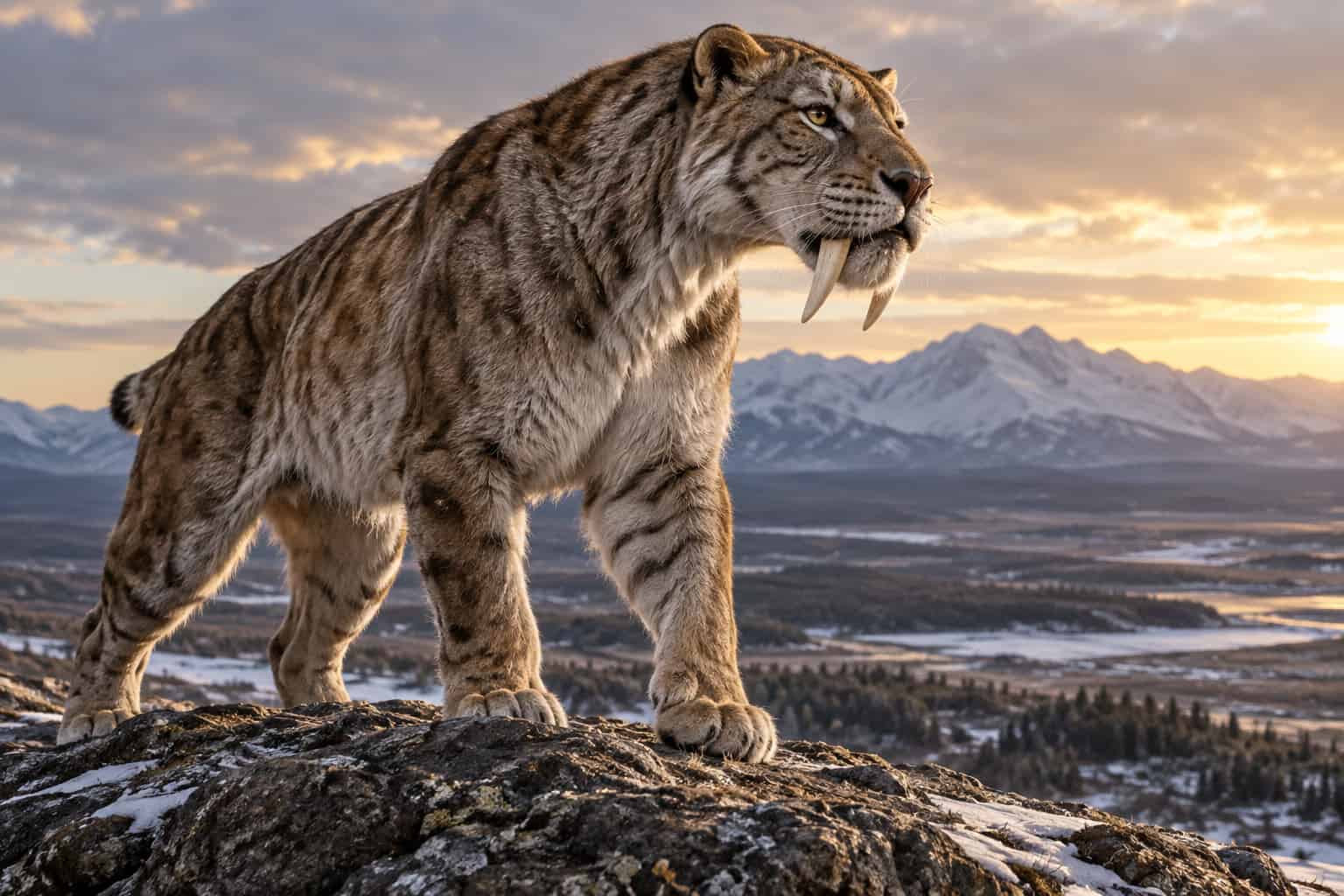
Long before modern lions, tigers and other big cats spread across much of the world, another powerful cat hunted large animals across open landscapes. Its name was Homotherium, commonly called the scimitar-toothed cat.
The Meaning of Scimitar-Toothed: Homotherium is commonly called the scimitar-toothed cat because of its unusual upper canine teeth. A scimitar is a sword with a curved blade. Homotherium’s canine teeth were shorter than the long saber teeth of Smilodon and were flattened from side to side, giving them a blade-like shape. The edges of the teeth were also finely serrated, meaning they had tiny tooth-like ridges that helped form a cutting edge.
Homotherium belonged to an extinct group of cats known as the saber-toothed cats. It lived across parts of Africa, Europe, Asia and the Americas during the Pliocene and Pleistocene epochs. The Pliocene lasted from about 5.3 million to 2.6 million years ago. It was followed by the Pleistocene, which included the repeated cold periods commonly called the Ice Ages.
Although Homotherium is often compared with the famous saber-toothed cat Smilodon, the two animals were quite different. Homotherium had shorter, flatter canine teeth, longer legs and a body that appears to have been better suited for traveling across open country.
What Was Homotherium?
Homotherium was a true member of the cat family, Felidae, the same family that includes today’s lions, tigers, leopards, cheetahs and domestic cats.
However, it belonged to an extinct branch of the cat family called Machairodontinae. These cats are usually known as saber-toothed cats because many species had unusually long upper canine teeth. Canines are the pointed teeth located toward the front of a carnivore’s mouth.
Its teeth were not as extremely long as the famous canines of Smilodon. This is one reason scientists distinguish scimitar-toothed cats such as Homotherium from other types of saber-toothed cats.
What Did Homotherium Look Like?
Homotherium was a large, strongly built predator, but its body did not have exactly the same proportions as a modern lion or tiger.
Its front legs were relatively long, while its back sloped downward toward the hindquarters. It had a short body, powerful neck and strong front limbs. These features gave the animal a distinctive appearance.
The strong neck and front of the body may have helped Homotherium control large prey. Its skull and jaws were also adapted to open widely, allowing the cat to use its large upper canine teeth.
Its legs suggest that it was capable of moving efficiently over considerable distances. This would have been useful for a predator hunting animals across large, open landscapes.
How Was Homotherium Different from Smilodon?
Homotherium and Smilodon are both commonly called saber-toothed cats, but they were not simply different versions of the same animal.
Smilodon had extremely long upper canine teeth, powerful forelimbs and a heavily built body. Its body shape suggests that it relied heavily on strength when attacking prey.
Homotherium had shorter, blade-like canine teeth and proportionally longer limbs. Its body appears to have been better adapted for traveling through more open environments.
The difference is important because “saber-toothed cat” does not describe a single species. It is a general name used for several extinct cats with enlarged canine teeth. Different saber-toothed cats evolved different ways of hunting and surviving.
Where Did Homotherium Live?
Homotherium had an enormous geographic range. Fossils have been discovered in Africa, Europe, Asia and North America.
Its habitats changed across this huge range and over the long period in which the genus existed. Evidence suggests that many populations used relatively open environments where large grazing animals were available.
However, Homotherium should not be pictured as living only on endless treeless grasslands. Recent evidence from Siberia shows that at least some populations lived in landscapes that included both meadows and forests.
This ability to live in different environments may have helped Homotherium spread across such a large part of the world.
What Did Homotherium Eat?
Homotherium was a carnivore, meaning that it ate meat. Its size and powerful body allowed it to hunt large herbivores, or plant-eating animals.
Studies of its teeth and fossils associated with the cats suggest that its prey included animals such as bison and horses. There is also evidence that young mammoths may sometimes have been hunted.
One of the most interesting sites connected with Homotherium is Friesenhahn Cave in Texas. The cave contained remains of scimitar-toothed cats, including young cats, along with many bones from young mammoths.
Scientists have interpreted the site as evidence that the cave may have been used as a den and that mammoths were among the animals hunted by the cats.
How Did Homotherium Hunt?
No human ever recorded a living Homotherium hunt, so scientists cannot know every detail of its hunting behavior. Instead, they study its skeleton, teeth, fossil sites and chemical evidence preserved in fossils.
Its long front limbs and body proportions suggest a predator adapted to covering more ground than heavily built saber-toothed cats such as Smilodon.
Once prey was caught, the strong front limbs could have helped hold the animal while the powerful neck and specialized teeth were used during the attack.
Scientists have also considered whether Homotherium may have hunted socially, meaning that several cats could have hunted or lived together. Some fossil evidence supports this possibility, but details of its social behavior remain uncertain.
Homotherium During the Ice Age

Homotherium survived into the Pleistocene epoch, a time when Earth’s climate repeatedly shifted between colder and warmer periods.
In northern regions, these cats shared their world with some of the most famous Ice Age animals, including mammoths, bison, horses, reindeer and cave lions.
Surviving in these environments required adaptations to cold weather as well as the ability to find enough prey across large landscapes.
Until recently, scientists had to reconstruct the outward appearance of Homotherium almost entirely from bones and teeth. Then an extraordinary discovery provided something paleontologists had never seen before.
The Frozen Homotherium Cub
In 2020, a frozen saber-toothed cat cub was discovered in permafrost in northeastern Siberia. Permafrost is ground that remains frozen for at least two consecutive years and can sometimes preserve ancient animal remains.
The cub was later identified as Homotherium latidens. Radiocarbon dating showed that it lived roughly 35,000 to 37,000 years ago.
Unlike an ordinary fossil skeleton, the frozen animal preserved parts of its body, including fur, muscles and soft tissues. This allowed scientists to examine features that bones alone cannot reveal.
The cub was only about three weeks old when it died. It had a dark coat, small ears, a large mouth, a very muscular neck and unusually long front limbs. Its paws were broad and rounded.
Researchers compared the cub with a modern lion cub of a similar age. The differences were striking. The Homotherium cub had a much more massive neck and longer front limbs. Its broad paws and small ears may have helped it live in a cold, snowy environment.
The discovery was especially important because it gave scientists their first direct look at the external appearance of this extinct type of saber-toothed cat.
A Closer Look at Its Siberian Habitat
The frozen cub has also helped researchers learn more about the environment in which some of the last Eurasian Homotherium lived.
Scientists examined tiny remains of plants preserved in sediment from the discovery site. These included pollen and other microscopic plant material. By identifying these remains, researchers can reconstruct the vegetation that once grew in an area.
The evidence indicates a landscape containing larch forest along with sedge, grass and wildflower meadows. This gives us a more detailed picture than the traditional image of a saber-toothed cat living only on open, treeless plains.
The region was also home to other large Ice Age mammals, including woolly mammoths, horses, reindeer, bison and cave lions.
When Did Homotherium Become Extinct?
Homotherium survived for a remarkably long period as a genus, but eventually it disappeared.
Fossil discoveries show that some populations survived much later than scientists once believed. The Siberian cub demonstrates that Homotherium was still living in northern Asia about 35,000 to 37,000 years ago.
Evidence from Europe and North America also shows that scimitar-toothed cats survived into the later part of the Pleistocene.
The exact reasons for their extinction are not known. Climate and habitats were changing, populations of large prey were changing, and Homotherium shared its environment with other powerful predators. More than one factor may have contributed to its decline.
Why Homotherium is Important
Homotherium shows how diverse the cat family once was.
Modern wild cats range from tiny species weighing only a few pounds to enormous tigers, but even this variety represents only part of the cat family’s evolutionary history. In the past, cats evolved body shapes, teeth and hunting adaptations that have no exact equivalent among living species.
Homotherium was one of those experiments in cat evolution: a long-legged predator with powerful front limbs, a muscular neck and blade-like canine teeth that spread across several continents.
Its fossils help scientists understand ancient ecosystems. And the discovery of the frozen Siberian cub shows that even after more than a century of studying prehistoric cats, remarkable evidence can still change what we know about them.
0 Comments