

The Balkan Lynx is a Critically Endangered subspecies of the Eurasian lynx. You can find the Balkan lynx in the remote, forested areas of the Balkans, a region in southeastern Europe.
Scientific Name: Lynx lynx balcanicus
Conservation Status: Critically Endangered
Lineage: The Balkan lynx is a subspecies of the Eurasian lynx and a member of the genus lynx.
Interesting Facts About the Balkan Lynx
- The Balkan lynx is the national symbol of Macedonia
- It is a distinct subspecies of the Eurasian lynx that has adapted to live in the rugged Balkan mountains.
- It is a stealthy, solitary hunter.
- A key population of Balkan lynx can be found in Mavrovo Park (North Macedonia) and the Sharr Mountains, which span across southern Kosovo and northwestern Macedonia.
Origins of the Balkan Lynx
The Balkan Lynx has lived in the Balkan Peninsula for thousands of years. Long ago, it roamed across much of southeastern Europe. By the early 1900s, its numbers dropped sharply from hunting and habitat destruction.
In the 1930s and 1940s, only about 15-20 lynx were left. After World War II, protections in places like Yugoslavia and Albania helped the population grow to around 280 by the 1970s.
But in the 1990s, wars and illegal activities like logging and poaching caused numbers to fall again, down to about 90 by 2000. Today, the Balkan Lynx is still struggling to survive, with only 40 to 50 left in the wild.
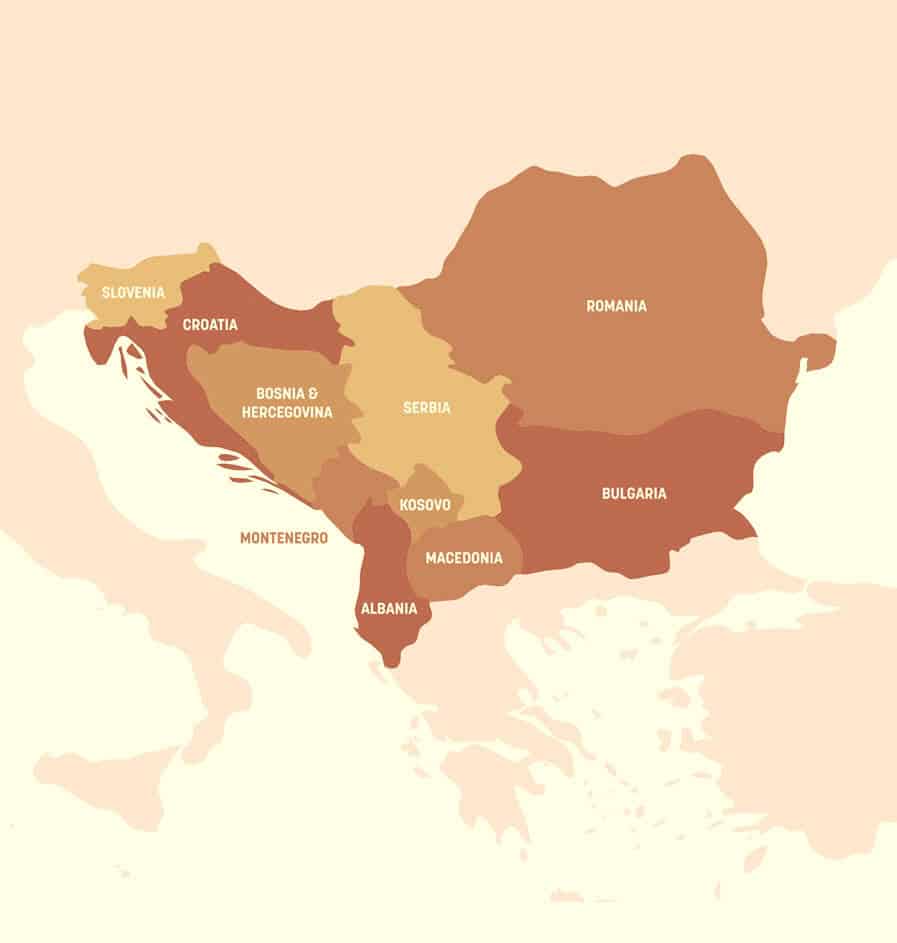
Image: Map of the Balkans
More about the Balkan Lynx
The Balkans is a region in southeastern Europe that includes countries like Albania, North Macedonia, Kosovo, Serbia, Montenegro, Bosnia and Herzegovina, Bulgaria, Croatia, and parts of Greece and Romania. It’s named after the Balkan Mountains and is known for its rugged landscapes, with mountains, forests, and rivers.
Balkan Lynx live in the southwestern Balkans, mainly in Albania, North Macedonia, and Kosovo, with a few possibly in Montenegro, Serbia, and Greece. Their favorite places are dense forests—deciduous, evergreen, or mixed—and mountainous areas between 300 and 2,500 meters high.
Key spots include Mavrovo National Park in North Macedonia and the Munella Mountains and Shebenik-Jabllanice National Park in Albania. They don’t move far but sometimes hunt in open shrublands or high mountain pastures in summer.
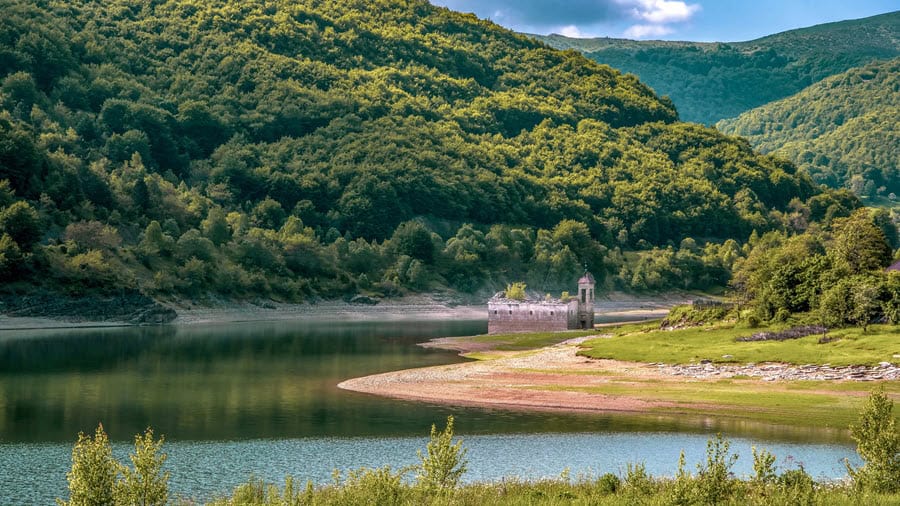
Image: Mavrovo, North Macedonia
What the Balkan Lynx Looks Like
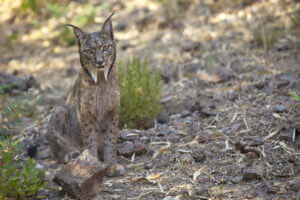
The Balkan Lynx is about 2.6 to 4.3 feet long (not counting its short tail) and stands 2 to 2.5 feet tall at the shoulder. It weighs between 40 and 55 pounds. Its fur is short, reddish or grayish with black spots, which helps it blend into forests. The belly, neck, and chin are whitish. It has long legs, large padded paws for walking on snow, and a short, black-tipped tail. Its triangular ears have black tufts, and it has sharp, retractable claws that don’t show in footprints.
Behavior
Balkan Lynx are solitary, meaning they live alone except when mating or raising kittens. They’re most active at dawn and dusk (crepuscular) and sleep during the day in thick bushes or trees.
They’re great climbers and can leap up to 7 meters to catch prey. They mark their territory with scent from urine, feces, or scratches on trees.
Males have bigger territories (220-700 km²) than females (100-200 km²), and a male’s territory often overlaps with those of females. Mothers and daughters sometimes share space.
How Balkan Lynx Communicate
Balkan Lynx are quiet but make sounds like meows, growls, hisses, or loud yowls during mating season.
Hunting and Prey
Balkan Lynx are stealthy ambush predators, using their sharp hearing and eyesight to spot prey from far away, even up to 250 feet. They stalk quietly, then pounce, killing with a bite to the throat.
Their main prey are roe deer, young chamois, and brown hares. They also eat smaller animals like rabbits, pikas, rodents, or birds, and sometimes young red deer or wild boar.
Balkan lynx rarely attack livestock, preferring to avoid humans. A lynx eats about 2-5 pounds of meat a day and can feed on one kill for several days if undisturbed.
Mating and Reproduction
Balkan Lynx mate between February and mid-April. Males and females come together only to mate, and males may mate with more than one female (polygyny).
The female is ready to mate for just a few days each season. After about 70 days of pregnancy, she gives birth to 1-5 kittens (usually 2-3) in a hidden den, like under rocks or in trees, around late May or early June.
Newborn kittens are blind, helpless, and weigh about 300 grams. The mother raises them alone, nursing them for 4-6 months and teaching them to hunt. Kittens stay with her for about 10-12 months before leaving to find their own territories.
Balkan Lynx in Culture
In North Macedonia, the Balkan lynx is a national symbol and even appears on the country’s 5-denar coin.
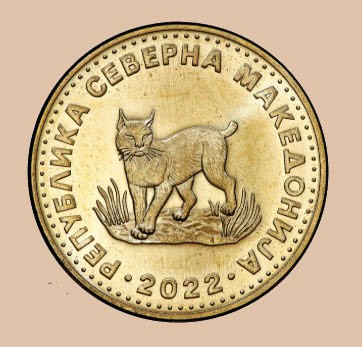
Lynkestis, an ancient region in Upper Macedonia, means “land of the lynx.”
In local folklore, especially in Albania, there are legends about the supernatural qualities of the lynx.
Balkan Lynx Conservation
The Balkan Lynx is Critically Endangered, with only 40-50 left, according to the IUCN Red List. The biggest threats are:
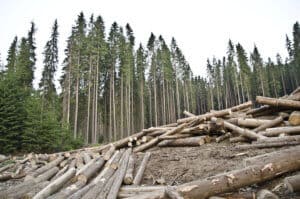
Habitat Loss: Illegal logging in Albania and North Macedonia destroys forests, leaving less space for lynx to live and hunt. Between 2000 and 2012, these countries lost 4-7% of their forests.
Poaching: People illegally hunt lynx for their fur or because they think lynx kill livestock. Their prey are also over-hunted, leaving less food.
Low Population: With so few lynx, it’s hard for them to find mates, especially since populations in Albania and North Macedonia are separated. This leads to inbreeding, which can weaken the species.
Albania banned Balkan lynx hunting in 2014, and penalties for killing lynx are now stricter, up to seven years in prison. The lynx was added to the Convention on Migratory Species in 2024 to increase cross-border protection. Even so, the lynx’s future is uncertain unless habitat destruction and poaching stop.
Your content goes here. Edit or remove this text inline or in the module Content settings. You can also style every aspect of this content in the module Design settings and even apply custom CSS to this text in the module Advanced settings.
Balkan Lynx Research Quotes
“The Balkan lynx Lynx lynx balcanicus is a subspecies of the Eurasian lynx distributed in the south-west Balkans, with relict populations in the Mavrovo National Park and surroundings in North Macedonia and the Munella Mountains in Albania, and with single individuals in Bjeshkët e Nemuna, western Kosovo. In 2015 the Balkan lynx was assessed as Critically Endangered in the IUCN Red List. Main threats involve small population size, limited prey base, habitat degradation, and poaching.” – Balkan lynx and the Balkan Lynx Recovery Programme (2021), D. Melovski, et al.









0 Comments